
BEN ABBOTT
Great Salt Lake Preservation
By Aimee L. Cook | Photography by Rebecca Kay
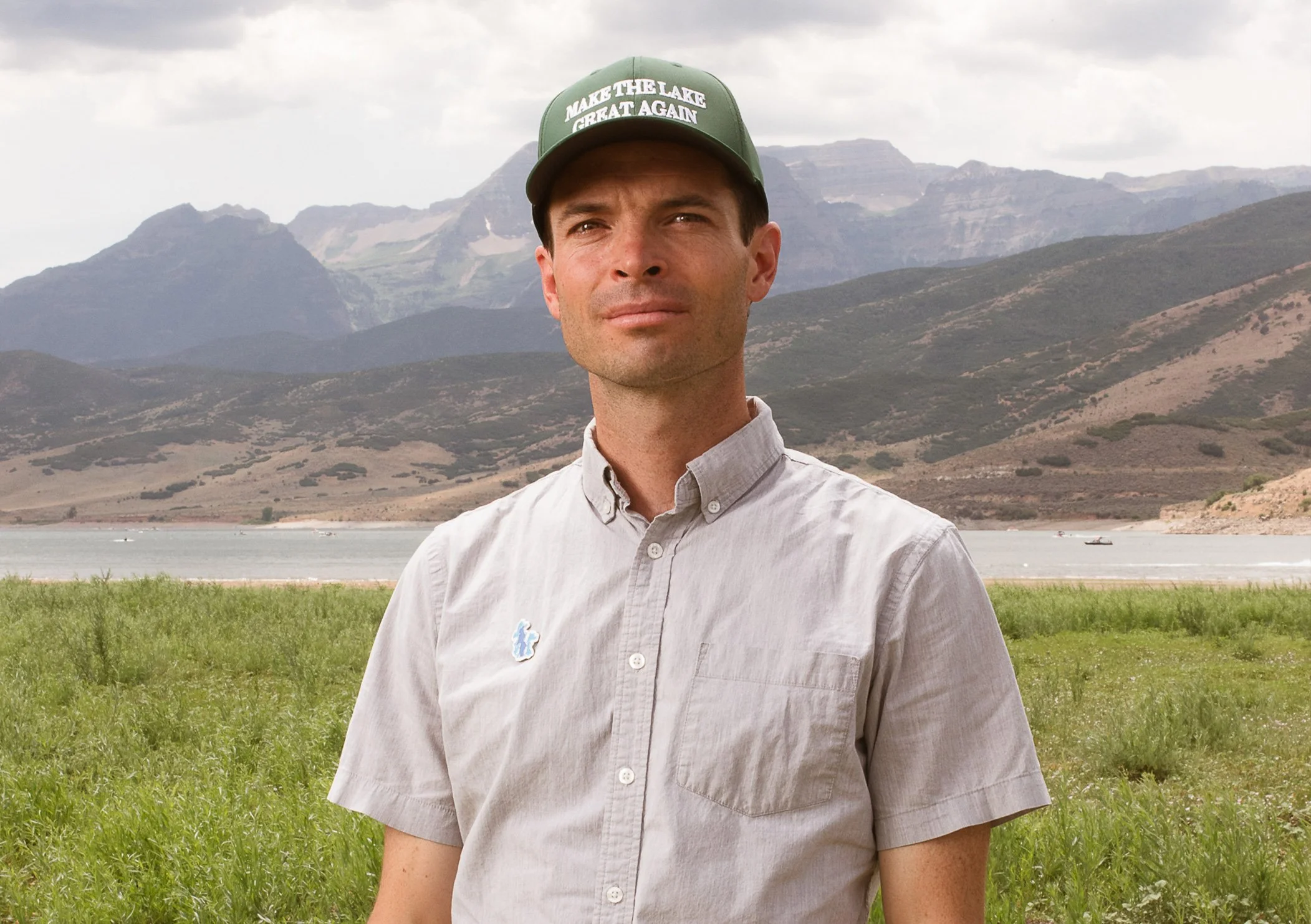
“WE DO NOT INHERIT THE EARTH FROM OUR ANCESTORS; WE BORROW IT FROM OUR CHILDREN.” This old quote from Chief Seattle captures much of what has driven Ben Abbott's work to protect Great Salt Lake.
Growing up, Ben was the kid who couldn’t get enough of National Geographic specials. He’d sit glued to the screen as cameras swept over arctic tundra, coral reefs, and sweeping river deltas. Those shows didn’t just entertain him. They wired something deep into his sense of who he was and what mattered. The natural world felt alive, interconnected. The more he learned, the more he realized how closely our personal and community well-being was tied to the health of the environment.
Today, Ben is a professor of ecology at Brigham Young University and one of the most recognizable voices in Utah’s fight to save the Great Salt Lake. But behind the science and the headlines is a person shaped by curiosity, shaped by fatherhood, and shaped by a single student’s undergraduate research project that changed the direction of his career.
A Path Built on Wonder
Ben’s academic path took him from Utah before it brought him back. He received his PHD from the University of Alaska, where he studied the effects of climate change on river networks. He then took a job with the French National Science Foundation in western France, where he worked for three years. It was a formative chapter — one that broadened his thinking and deepened his commitment to understanding how human choices ripple through ecosystems.
“Everything that we do in society, from our health to having children to the economy, all depends on having a healthy environment,” Ben explained.
The Moment That Changed Everything
That moment came in 2017 when he began working at BYU — and it came from an unexpected source.
Isabella Errigo was an undergraduate student at BYU when she began investigating the health impacts of air pollution connected to the Great Salt Lake. As the lake loses water, its exposed lakebed releases dust laced with arsenic and other harmful particulates. That dust doesn’t stay at the shoreline. It travels. It enters the air over neighborhoods, schools, playgrounds, and homes across the Wasatch Front.
Errigo’s research was careful, clear, and deeply unsettling. Ben was moved. Not just professionally, but personally. Here was a young student pulling back the curtain on a crisis happening in his own community, in the air his neighbors were breathing. He saw a lake that had quietly been losing water for decades — and a public that largely didn't know how serious the situation had become.
“It turns out that we have thousands of people dying prematurely every year because of our unhealthy air,” Ben shared. “About ten times as many people die from air pollution as from car crashes in our state.”
That lit a fire in him. He began looking more closely at the lake’s decline, the data, the policy gaps, and the human cost of inaction. The more he looked, the more urgent it seemed. And the more urgent it seemed, the harder it became to stay quiet.
A Father’s Lens
Ben is a father of four. That fact is inseparable from his sense of mission.
When he talks about the Great Salt Lake, he’s not just reciting data points. He’s thinking about his children — the Utah they’re growing up in, and the one they’ll inherit. Will they be able to breathe clean air? Will they know the lake as a living, thriving ecosystem? Or will they grow up with a dust-swept lakebed where water once was?
Those questions are not abstract for him. They’re immediate and personal. He feels it’s now his responsibility, and they push him to do more than just publish papers.
He shows up at town halls and legislative hearings. He takes reporters’ calls and translates dense science into language anyone can understand. He stands in front of student groups and community gatherings and explains, patiently and clearly, why this matters — not to some future generation, but to us, right now.
“There is a much bigger burden to our society that is causing sickness and even death that we don’t think about, and that is environmental pollution,” Ben added.
Protecting the lake became protecting a legacy. Every policy change he advocates for, every conversation he sparks, every person he pulls into the movement is part of what he wants to leave behind for his kids.
“As an academic, I thought that my main contributions would be scientific breakthroughs,” Ben added. “What Isabella taught me was when we communicate clearly what we are learning about the environment, the world can change.”
Building a Movement
In 2023, Ben led a team of 32 scientists who published a landmark warning: without significant change, the Great Salt Lake could largely disappear within five years. The report made national headlines and rattled the state legislature. Suddenly, a crisis that had simmered quietly for decades was impossible to ignore.
But Ben understood that a report, no matter how powerful, has limits. People needed more than data. They needed a way to act.
That’s where Grow the Flow came in. The movement is built around a simple but urgent idea: the lake is losing water, and we can bring it back by changing how we use and manage what we have. According to the data provided by Grow the Flow, the Great Salt Lake is 32.7% full at press time. Grow the Flow knits together scientists, farmers, faith communities, families, and business leaders around that shared goal. It makes water policy feel personal and winnable.
“One of the learnings from around the world is that all these [terminal] lakes are in decline, and there is not a single example of one that has been restored,” Ben said. “This is one of the great unsolved ecological challenges of our generation. When these lakes dry up, so do the communities around them.”
Ben’s role in the movement reflects his nature: optimistic, practical, and deeply people-focused. He doesn’t lead with despair. He leads with possibility. He reminds people that other communities can reverse the decline of struggling lakes, and that Utah has everything it needs to do the same. Ben says what has been missing is collective will — and that's something people can actually build. And there is no time to waste.
“I don't think we have another choice; we have to save the Great Salt Lake, and we do that by conserving water,” Ben explained. “We now have a commitment from the Governor, the Speaker of the House and the Senate president to restore the lake by the Olympics. That is a huge step forward.”
Saving the Great Salt Lake will require statewide buy-in. Everyone has a role to play to reverse the effects of the declining lake. That means as a society we will be inconvenienced; we have to reduce our water footprint. The 2026 Legislative Session laid the groundwork for transformation by passing HCR 9, HB 410 and HB 3.
Utah’s H.C.R. 9 asks the federal government to help save Great Salt Lake, aligning with President Trump’s call to “make Great Salt Lake great again.” The state hopes to buy and lease water rights but can’t afford the full cost, prompting Governor Cox’s $1 billion federal request.
House Bill 410 provides $2.75 million annually through 2030 to lease agricultural water — reduced from the original $5 million — but still gives the Commissioner’s Office a stable planning base.
House Bill 3 invests nearly $90 million: $30 million toward U.S. Magnesium water rights and about $60 million from a federal settlement for the Commissioner’s Office. The State must seek private donations to offset the U.S. Magnesium purchase, and only $10 million of the settlement is available this year. Public oversight will be key to ensuring these funds truly reach the lake.
Action must be taken by 2027. Federal and state funding will first supplement proven solutions, like voluntary water markets, then assist with other large-scale changes or pipelines.
The Man Behind the Mission
There’s a particular kind of scientist who can hold data and humanity in the same hand. Ben is that kind of scientist.
He traces a line from the kid who watched nature documentaries on Saturday mornings, to the researcher who studied watersheds across Europe and beyond, to the professor who was stopped in his tracks by a student's work on air quality, to the guy who now fights, every day, for the state his children call home.
He isn’t driven by fame or recognition. He’s driven by the belief that the people around him — neighbors, students, legislators, parents — can do remarkable things when they understand what's at stake. For him, it was a no-brainer.
“No government anywhere has fixed it; we have to do things differently,” Ben added. “If we want a chance to be the first community in the world to be good stewards, we have to invent a new relationship with water, and that is going to require having a new relationship with one another.”
The Great Salt Lake is still in crisis. The dry lakebed still stretches farther than it should. But the movement around it is alive, and at the center of that movement is a man who simply refuses to give up on the place and the people he loves.
“The way we treat our home is a reflection of who we are as people; for me, it comes back to, ‘who do we want to be remembered as’,” Ben shared. “We can flip the narrative to, ‘how awesome would our life be with a full lake. A full lake means we have more rain and snow, a more stable climate, cleaner air, a stronger economy and healthier kids. That is the future that I am fighting for. People need to take a step of faith and trust one another again.”
To learn more or get involved, visit Grow the Flow and find out how your everyday choices can make a real difference. Also visit justserve.com to learn more about volunteering in various projects.