
Coffee Roasting
By Taylor Hartman | Photography by Dung Hoang
CAFFE IBIS
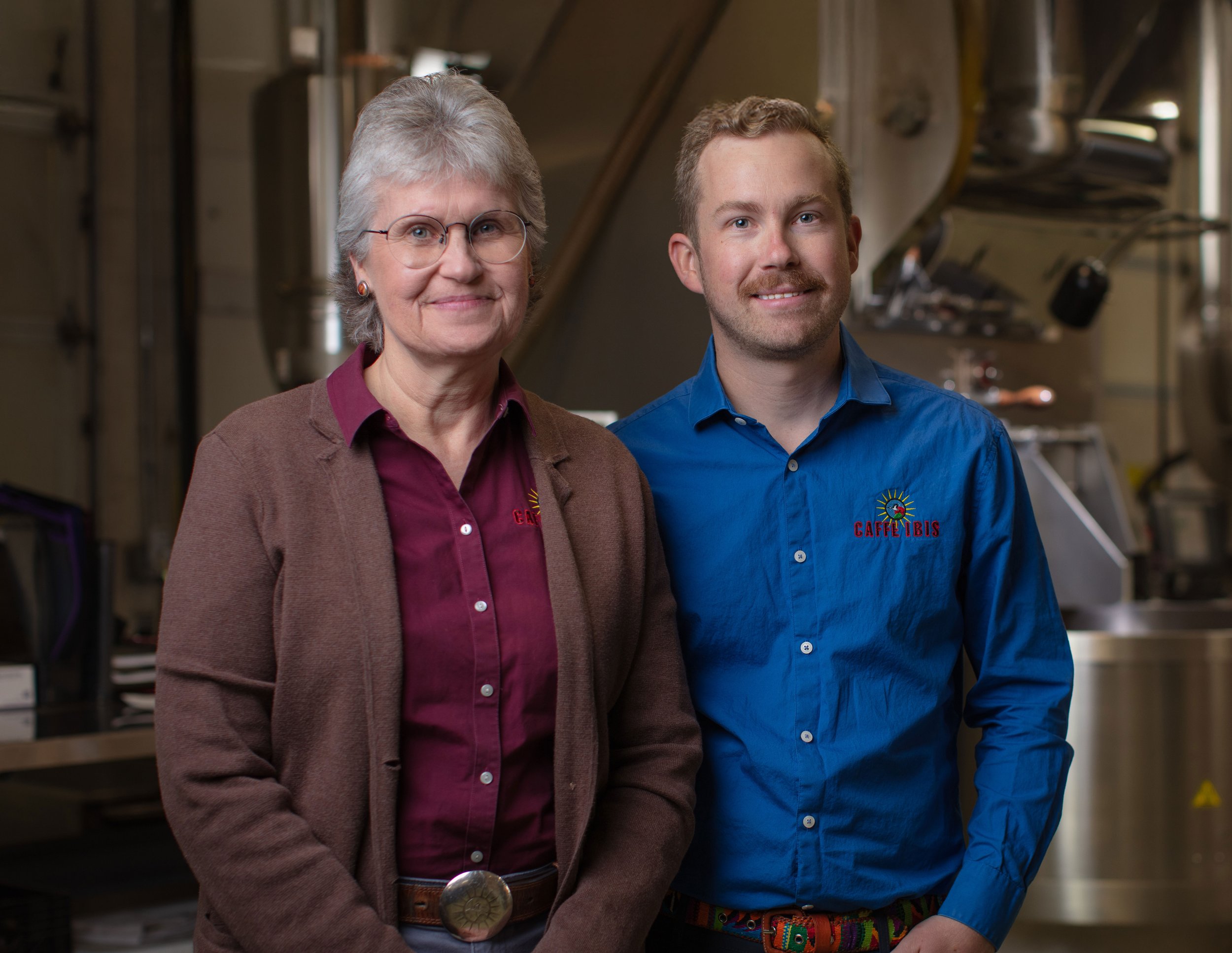
LESA WILSON DIDN’T SET OUT TO RUN A COFFEE ROASTERY, but Caffe Ibis became part of her life soon after she arrived in Logan in 2006. Walking into the company knowing nothing about roasting or production, Lesa was hired to help untangle the bookkeeping for a small, mission-driven business that still operated with stacks of paper and a twelve-person crew.
The work drew her in and kept her. She began to understand how deeply the founders, Randy Wirth and Sally Sears, had tied the company’s identity to community, environmental stewardship, and the belief that business should do more than just provide a product.
Caffe Ibis had been woven into the fabric of downtown Logan since 1976, beginning as a natural foods store before evolving into a specialty coffee roaster. Today, its roastery and Café remain the center of operations, supplying coffee throughout Cache Valley and to wholesale partners across Utah. Nearly 50 years on, the company has become one of the state’s most enduring independent businesses as well as the place where Lesa found a calling she didn’t expect.
Randy Wirth and Sally Sears built Caffe Ibis around the conviction that business should serve both people and place. They were early adopters of organic practices, advocates of fair trade sourcing, and among the first roasters to participate in the Smithsonian Migratory Bird Center’s Bird Friendly program. Their commitment to responsible farming and biodiversity shaped the company long before sustainability became mainstream in the coffee world.
Lesa carries that legacy forward, but she isn’t alone. One of the people who understands that history most deeply is Edie DeVilbiss, who leads sales, marketing, and education for Ibis.
“When you look back over the decades, it’s pretty incredible how our consistent support in the same core areas and organizations really adds up in significant ways. It makes a big difference for a lot of people, birds, and the planet, both in our community here and in the communities where coffee is grown,” Edie said.
A Tradition of Stewardship
When founder Sally Sears retired at the end of 2019, Lesa stepped forward to keep Caffe Ibis independent. She talks about ownership the same way she talks about sourcing and stewardship — with a sense of responsibility rather than ambition.
“I didn’t want to see us get sucked up by some large corporation or sold to somebody who didn’t care about the people or the customers or the community that we were involved in,” she said. “So I guess that’s what triggered me to make that move.”
Tom Wilson, Lesa’s son and the company’s director of coffee, grew up inside that mindset. He speaks about specialty coffee with the same seriousness artists give their craft, pointing out that their environmental commitments weren’t a branding strategy. They were simply the way Randy and Sally operated.
“I was just brought up in a system where we chose compostable silverware … because it didn’t matter that it cost twenty times as much. It’s just what you do because it’s right,” he said.
Tom’s work pulls Caffe Ibis’s long-held values into the evolving world of specialty coffee. Processing methods shift, new fermentations appear, and growers experiment with techniques that rewrite what flavor can be. But even as the industry pushes forward, Tom approaches coffee the same way he approaches everything at the roaster — slowly, attentively, and with an understanding that the smallest decisions carry weight.
A lot of that comes back to how he learned to taste. “A big portion of learning to do that is connecting memories [such as] when I want to say that something tastes like peach. It’s like, ‘what is the memory that does that?’” he said. “You don’t always, in the moment, appreciate the magnitude of that.”
Company Rooted in Community
Edie sees the company’s impact in the relationships it supports across the state.
“I really think of it as driving the impact we’re having … the more amazing coffee we put out there, the less crappy commodity, unethical, and deforestation-contributing coffee makes its way into the world,” she said.
That responsibility shows up locally, too. Caffe Ibis donates coffee throughout Cache Valley, including to the William A. Bernard Warming Center in the winter months. Tom Wilson feels the weight of those small acts.
“When somebody tells you whatever thing you did or donated to really help them out, it definitely makes it easier to take that next day,” he said.
For Lesa Wilson, giving back is part of the company’s identity.
“Being able to say yes to organizations that come along and say, ‘you know, we could use some help with this or that’ … that’s just a part of who we want to be as a company,” she said.
All three speak about Caffe Ibis with the same quiet certainty. None of them set out to run a legacy brand, yet that’s the work they’ve taken on. Their choices are shaped by the company’s long history and by the question Tom returns to often: “What would Randy do?”
As Caffe Ibis moves into its next 50 years, the team keeps the company grounded in the principles that have always guided it — stewardship, community partnerships, and thoughtful decisions that hold up over time.
Edie hopes those values extend beyond the roastery. “I hope that coffee, the ritual of brewing, and enjoying it can be one of the things that helps bring us together,” she said.