
Cardiac Imaging
By Taylor Hartman | Photography by Rebecca Kay
CARDIASPACE

DR. MARK IBRAHIM DIDN’T BEGIN HIS CAREER WITH THE INTENTION OF FOUNDING A HEALTHCARE COMPANY, but the path that led him there started long before he made the leap into entrepreneurship.
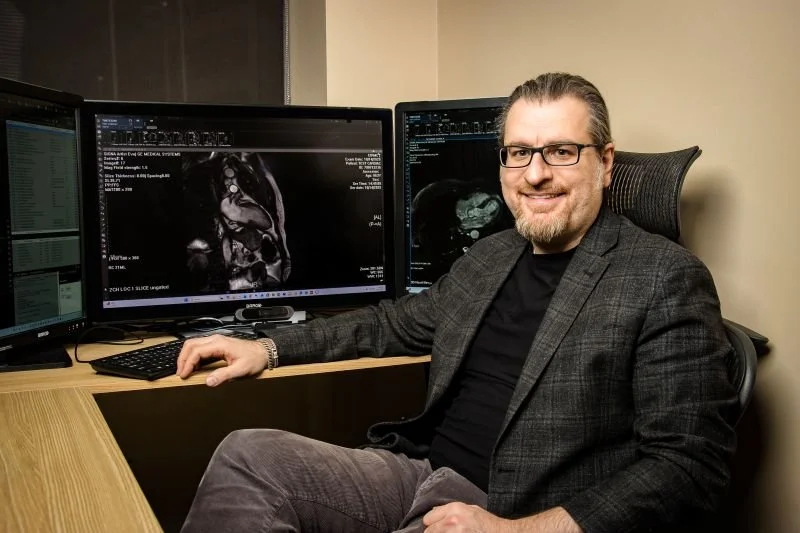
Originally from Syria, Ibrahim immigrated to the US to pursue medical training, ending his school career at the University of Utah, where he joined the faculty as an advanced cardiac imaging specialist — a field that requires both deep expertise and the willingness to embrace rapidly evolving technology.
During those formative years, he became one of the relatively few cardiologists nationwide to earn board certification in all cardiac imaging modalities and to train extensively in interpreting sophisticated cardiac Magnetic Resonance Imaging (MRI) and Computed Tomography (CT) scans.
But it was the COVID-19 pandemic that exposed a critical fault line in healthcare systems nationwide. As hospitals canceled nearly all cardiac diagnostics that risked exposing providers to aerosols, entire categories of testing, especially those involving transesophageal ultrasound probes, were abruptly shut down. For Ibrahim, the consequences were immediate and alarming.
“When the pandemic hit, I realized the system was dysfunctional at its peak,” Ibrahim recalls. “Traditional cardiac diagnostics were canceled, and a large number of people delayed care, some with serious, even fatal outcomes.”
At that moment, Ibrahim saw a path forward. Advanced cardiac imaging modalities such as cardiac MRI and CT were not only safer during a respiratory pandemic but also more precise. Many hospitals already owned these scanners. What they lacked were the highly specialized physicians capable of overseeing, performing, and interpreting advanced cardiac imaging. Moreover, images generated by these machines could be securely transmitted to experts anywhere in the country, a model common in general radiology but still underutilized in the highly specialized field of cardiac imaging.
For Ibrahim, the idea that followed was simple and transformative. If hospitals already had the equipment, why not enable them to offer advanced cardiac diagnostics? If the specialists were scarce, why not empower them with AI-enabled workflows to dramatically increase efficiency and serve more patients? And if a patient’s life might depend on faster, less invasive diagnostics, why should access be determined by their ZIP code?
That gap — between what hospitals had and what patients needed — became the catalyst for everything Ibrahim built next.
Technology, Disruption, and the Rise of a Utah-built Model
As Ibrahim watched the cracks in the system widen, a different model of cardiac diagnostics began to take shape in his mind — one built on networks, modern technology, and smarter use of existing resources. He recognized that advanced cardiac imaging could replace many of the traditional procedures patients had long endured, including those requiring scopes or invasive tools. Most hospitals already had the scanners capable of performing state-of-the-art cardiac imaging. These machines were used daily for brain scans, trauma assessments, and routine cross-sectional imaging. Yet the cardiac-specific protocols that transformed those same scanners into powerful diagnostic tools were rarely utilized.
The reason was simple: without trained specialists to guide technicians, ensure image quality, and interpret the results, the technology sat underutilized.
This disconnect became the foundation of Ibrahim’s solution. He envisioned a centralized “hub” equipped with AI-powered workflows and staffed by highly skilled cardiac imagers who could remotely guide hospital scanners, standardize cardiac imaging protocols, and interpret complex scans with precision. Rural hospitals, regional health systems, and even urban facilities strained by staffing shortages could plug into that hub through secure digital infrastructure. Encrypted VPN networks enabled the safe transmission of medical images, and modern connectivity meant distance no longer had to dictate the level of care a patient received.
Ibrahim built CardiaSpace around that premise — turning hospital scanners scattered across the country into a unified platform for advanced cardiac imaging. Designed and operated from Utah, CardiaSpace quickly achieved product–market fit, and its services became highly sought after by many healthcare facilities across seven states as of 2025.
After completing his advanced cardiac imaging fellowship at the University of Utah, and later joining the faculty, Utah became the place where Ibrahim’s clinical skills sharpened, his ideas matured, and his long-term vision solidified. His time at the David Eccles School of Business further accelerated his trajectory, equipping him with the strategic and operational skills needed to build the CardiaSpace brand and scale it rapidly.
“Utah became home. It’s where I finished training, where I started my career, and where the idea for all of this began,” he said.
The unique landscape of academic medicine, innovation, and entrepreneurial collaboration in Utah offered something he hadn’t encountered elsewhere — a community where new ideas could gain traction quickly, and where people were eager to invest in a forward-thinking model of care.
Many of the early contributors to CardiaSpace were students Ibrahim had taught, mentored, or worked alongside at the University of Utah. They believed in the mission and stepped into roles that helped shape CardiaSpace’s growth. As he describes it, “I brought some of my students into the company. It’s incredible to get that sort of support and to have talented people believe in your idea so much. I would not have been able to scale the company without their help.”
Their involvement highlights a uniquely Utah dynamic — one where the line between academic training and entrepreneurial opportunity is comfortably fluid, and where young professionals often step into meaningful roles early in their careers.
Through all of this, Ibrahim has kept the mission centered on one principle: expanding patient access to advanced cardiac diagnostics and confronting heart disease — the leading cause of death worldwide. And as CardiaSpace continues to grow from its Utah roots, he credits not only his team and mentors, but also the unwavering support of his wife. “None of this would have been possible without Stephanie believing in me and in the mission,” he added.
Carrying a New Standard Forward
What began as a response to system failures during the pandemic has grown into a model that reimagines how cardiac diagnostics can — and should — reach patients. From Utah, Ibrahim built CardiaSpace, not as a tech venture or medical startup, but as a vehicle for access — a way to ensure that geography, staffing shortages, or outdated workflows don’t determine who receives life-saving care.
His approach echoes a broader truth about the state he calls home. Utah has always been shaped by people willing to build new systems when the old ones fell short, and Ibrahim’s vision fits squarely within that tradition. By combining expertise, technology, and a deep commitment to equity, he’s helping redefine what’s possible for cardiac care, both here in Utah and across the country.
FACES of Utah profiles the leaders and change
makers shaping our state.
Recognized for your impact?
[ Request Media Information ]