
Corporate Leadership
By Richard Markosian | Photo courtesy of Case Lawrence
CASE LAWRENCE
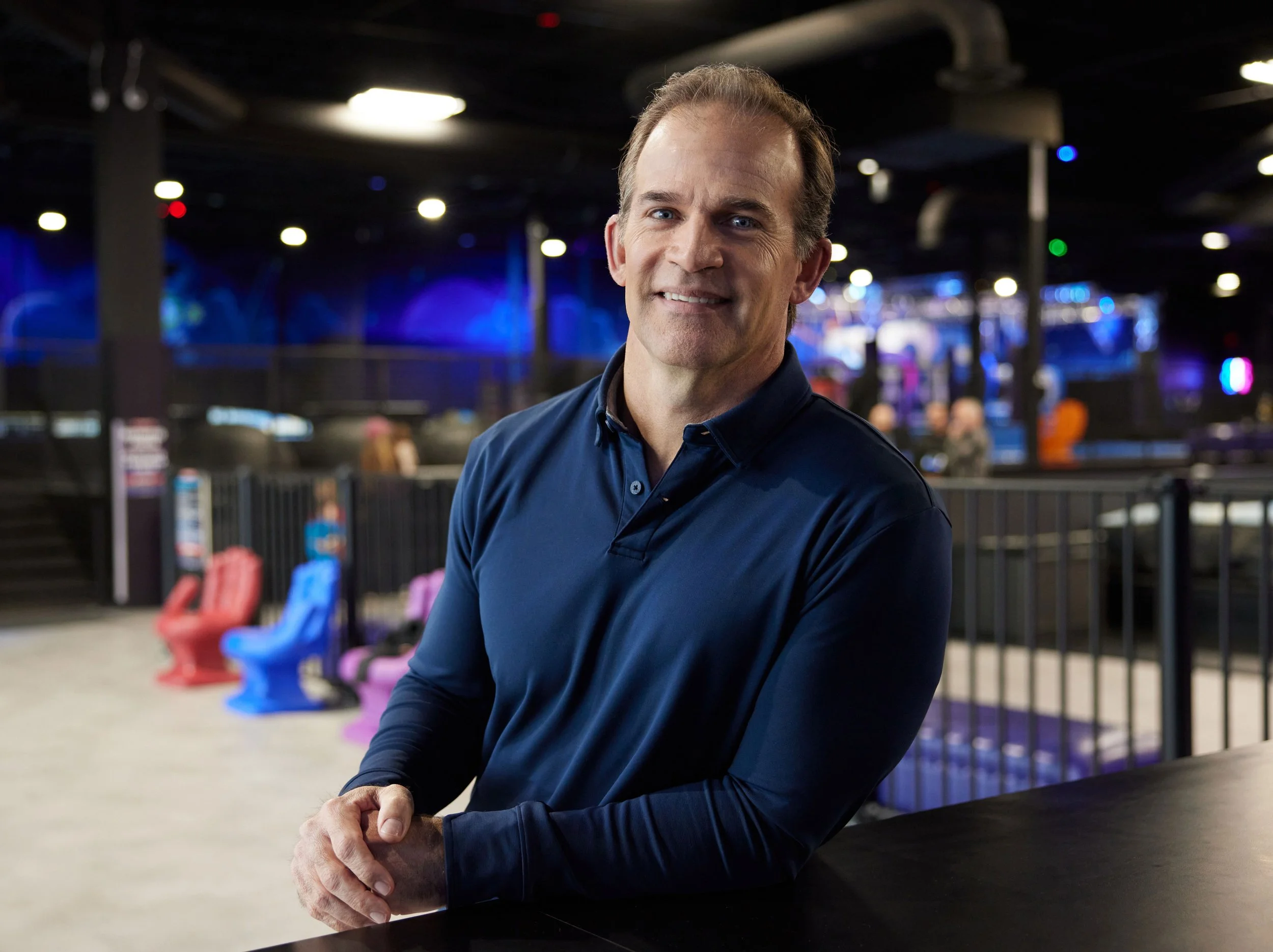
ELON MUSK FIGURED OUT HOW TO SEND ROCKETS TO SPACE BY REUSING ROCKET BOOSTERS. Case Lawrence figured out how to reuse millions upon millions of empty, abandoned big box stores to build community spaces for kids to get their bounce on. While one entrepreneur launched rockets, another found launching kids could also be highly lucrative.
But Lawrence’s story was anything but a clear vertical trajectory. We will return to that part of the story, but before we do, it’s worth tying Case’s story into our larger discussion on city economic development.
Case pointed to an image on our wall of a 1929 Schipler photograph of Salt Lake City’s Main Street, showing a row of narrow, brick-fronted buildings; a jeweler; a café, a photography studio, each one a small dream. A reminder that cities were once built one merchant at a time. I mentioned how I was revisiting that theme in our next issue of Faces. It turns out he had quite a bit to say about economic development and Main Street.
“We sacrificed Main Street to a fad,” Case tells me. He means the big-box era — those Walmarts, Circuit Citys, and Toys”R”Us stores that hollowed out small towns from Cheyenne to Lander. “And now the fad is gone. We’re left with millions of square feet of empty boxes.”
If that was a problem, Case has made a career out of turning problems into playgrounds.
A Repentant Lawyer in the Dot-Com Storm
Case calls himself a “repentant lawyer.” After BYU, he went to Duke Law, fully expecting to become a prosecutor. One year of required coursework quickly cured him. “I realized I didn’t want to argue for a living.”
Meanwhile, the dot-com boom was exploding. He moved to Menlo Park to work in venture capital and soon found himself helping merge a young South African entrepreneur’s company, X.com, with PayPal. The entrepreneur was Elon Musk.
Watching founders like Musk up close lit something in him. “I didn’t want to just service entrepreneurs. I wanted to be one.”
He launched a flex-space concept called Cargo Bay — “WeWork meets warehouse” — which took off until the 2008 collapse. With two personally guaranteed loans totalling $18 million, he spent two years just trying to avoid bankruptcy. By what he calls “miracles and paperwork,” he did, but he emerged with no job and no plan.
Then came the moment that changed everything.
The Day the Trampolines Took Over
During a family trip to San Francisco, a friend told him to visit a strange new attraction inside an old Presidio hangar: a trampoline park. Case had never heard of such a thing.
“We walked in and it was wall-to-wall trampolines, music blasting, people sweating, kids flipping everywhere,” he says. His boys were nine and seven. “They absolutely lost their minds.”
Driving home he thought: Maybe I could do one of these. Maybe as a side hustle while I look for a real job.
He built one. Then another. Then a third. All successful. Even then, he didn’t immediately realize he’d stumbled into an industry.
It took the belief of the Peary family office — longtime Silicon Valley real estate innovators — to unlock the capital he needed to scale. With that backing, Sky Zone took flight. Parks grew from 12,000 square feet of trampolines to 60,000-plus square feet of slides, obstacle courses, ninja runs, climbing walls — whatever kept kids active and off screens.
“Play isn’t a fad,” Case says. “Active play is more important than ever.”
COVID: The Seven-Month Free Fall
If there was ever a business built to suffer during the pandemic, it was indoor trampoline parks.
“We were shut down everywhere,” Case says. Across the Sky Zone system — roughly 300 parks worldwide — the average closure length was seven and a half months. No revenue. No PPP eligibility either, because private equity was part of their ownership structure.
“We were the poster child for what PPP was intended for,” he says. “But we didn’t qualify. And the courts said we still had to pay rent.”
They negotiated with landlords. They begged managers to stay on partial furlough. Incredibly, most did. “There were dark days. It truly looked like we wouldn’t make it.”
But when the lockdowns ended, something remarkable happened: families charged out of their homes desperate for physical experience. Sky Zone boomed harder than it ever had.
“We survived,” Case says. “And now we’re thriving.”
Why Utah Keeps Building Strange, Successful Things
Talk to Case long enough and the conversation inevitably turns to Utah’s peculiar streak of entrepreneurial success — from WordPerfect and Omniture to Crumbl, Swig, Just Ingredients, and Built Bar.
Part of it, he believes, is inherited culture: a mix of Protestant work ethic and frontier risk tolerance.
“Utah was founded by people who took insane risks,” Case says. “If you left Poland or England in the 1800s to come here, it was a one-way trip. I wonder if over generations that self-selects for people who take big swings.”
And part of it is just … weirdness. “We’re a bunch of weirdos here,” he says. “I embrace it.”
Training the Next Generation of Builders
Case now teaches Entrepreneurship 101 at BYU. He shares a hallway with Jazz owner Ryan Smith, who teaches the class next door. They’re part of a growing movement at the Marriott School to let practitioners — people who’ve actually built companies — teach the real lessons.
He speaks highly of BYU’s Sandbox program, which lets student founders earn up to a year of academic credit while building companies with mentorship and funding. Companies like Owlet came straight out of that ecosystem.
“There’s real momentum among these students,” Case says. “It’s electric.”
Escaping the Algorithms
Before we wrap, I ask him about something I’ve been writing a lot about lately: our bifurcated media world, the echo chambers created by algorithms, the collapse of shared reality.
“I think we all need to touch grass more,” Case says. “Get off social media. Go deeper. Read books. Talk to real people.”
He points to Utah’s new cell-phone-free classrooms as the most hopeful development he’s seen. “Teachers say it’s a game changer.”
And in a way, everything he builds — whether it’s a trampoline park or a book — is built around the same belief: real, physical experience matters.
Case’s new book, Off the Ground: From the Brink of Bankruptcy to a Billion-Dollar Trampoline Empire, comes out January 20, and is available now for preorder.