CHRISTMAS BOX HOUSE - CELESTE EDMUNDS
Foster Children Advocacy
By Tamara S. Wolfe | Photography by Rebecca Kay

“I THOUGHT I KNEW WHAT PAIN WAS, BUT THIS WAS THE WORST EVER. I would never see my brother and sister again.”
Celeste Edmunds was nine years old, standing in the lobby of the Salt Lake City and County Building.
After being shuffled from home to home, Celeste and her garbage bag had been thrown in with the Hatts, the family about to adopt her.
“I was surprised to see my caseworker,” Celeste says. “I hadn’t seen her since she dropped me off at the Hatts a thousand years ago.”
“Celeste, I have a wonderful surprise for you,” the caseworker said. “Your brother and sister are here, and we arranged it so you will all be adopted together.”
Celeste’s sister Tawny, now seven, and brother Austin, two, already knew.
They rounded the corner and ran to her.
Austin wrapped his tiny arms around her. He was not letting go.
“He thought I had abandoned him,” Celeste says. “I told him that I am here now.”
The caseworker looked ill. “I’m so sorry,” she said. “Being adopted today means you are all being adopted simultaneously. Not into the same family.”
Austin had to be pried away.
“That was a hurt I still cannot describe,” Celeste says.
Celeste had been the leftover pick from a photo binder of foster children, chosen as a Christmas present for the Hatts’ daughter. She was meant to be the fix for Kathy Hatt’s miscarriages and her failing marriage with Kent. She became a possession instead, unwanted by all three Hatt siblings, and prey to Kathy’s torture.
Celeste told herself to comply, just to survive. A skill perfected since birth.
She was born in West Valley, to Lynn and Veda Anderson. Both addicts.
Lynn played in a bar band and came home drunk, when he came home at all. He popped pain pills for the polio that left his leg crippled. And Veda would cry and scream, until knocked out from drugs.
All three siblings took their first breaths addicted.
Celeste became their mother at age seven.
She walked Tawny to school. At recess, she watched her sister through the chain-link fence. She fixed boxed mac ‘n’ cheese for dinner and gave Austin his bottle.
When their parents raged, the girls hid in a closet and played a game, naming the places they wished to be.
For Tawny, it was fun.
For Celeste, it was their rescue.
One night, she begged her father to stop yelling. He hurled her across a table. Glass broke, piercing her leg as her head struck the floor.
But when the house went quiet, she would tuck Tawny into bed and sing Silent Night.
Every night.
Then there were the knocks. Men dropping ‘things’ off while Veda slept. Celeste followed her mother’s rule to answer the door.
A reeking man showed up. He had pills for her mother, but he was not leaving without the cash Veda owed.
There was no money.
“He grabbed my arm, pulled me into the bathroom with him, and locked the door,” Celeste says.
He raped her. Laughed. Handed her the pills and told her the debt was paid.
“I learned to give these men what they wanted so they would not abuse my sister.”
Celeste, Tawny and Austin were taken from their parents, pulled from a motel on State Street.
Police knocked this time. Lynn hid under the bed. Veda cried.
“You can’t take my dad!” Celeste screamed.
They handcuffed Lynn and jailed him for check fraud. Veda went to rehab after rehab. And the three siblings were juggled by relatives, friends, and foster homes.
“All I had for a suitcase was a big black garbage bag,” Celeste says.
Once, Celeste and Tawny visited their mother in rehab. While Veda sat in therapy, a man claiming to be her ‘friend’ was put in charge of the children.
As soon as no one could see, he pulled Celeste into the basement laundry room and shoved her onto the concrete floor.
“My spirit seemed to slip out of my body,” Celeste says.
“I wondered where Tawny was.”
Veda’s next rehab was in Detroit. It allowed children. Austin rode there with Veda. Celeste and Tawny flew in. But with no child supervision, it became a playground for predators.
In its furnace room, a tag team of teens took their turns with Celeste. A deal she made so Tawny would not be touched.
Yet when she slammed two Barbies into the face of a girl who bullied her sister, Celeste was deemed a threat.
And the siblings were split, with no goodbyes.
Tawny and Austin were sent to Salt Lake for adoption. Celeste and her garbage bag were tossed into a New York rehab with Veda, then back to a foster home, where she was granted one last visit with her father.
She rose at five and waited for him on the porch.
“Dad!” Celeste cried when she saw him.
“When my dad was sober, he was my happy place,” she recalls. “He told me how proud he was of me, that I would grow up to do great things.”
He brought her a box of gifts. One for every holiday he would miss.
They went to a baseball game and walked to the movies. On the way home, he carried her.
On a leg that could barely carry him.
“Do you love your medicine more than me?” Celeste asked.
“No sweetie. I will never love anything as much as I love you.”
He told her what had happened was never her fault. Words she still keeps.
They drove to 7-Eleven.
Funyuns and chocolate milk. Their special thing, before their final goodbye.
That night, Celeste washed the chocolate milk container. She wiped the remnants from the Funyuns bag. And placed both in her garbage bag.
“That trash was my treasure,” she says.
The only evidence she had ever been loved.
Stolen once she was left to the Hatts, by one of the brothers. In its place, his note: Celeste is a Dope.
Kathy strangled her with words. Ripped up her ninth grade promotion dress. Chopped off her pony tails. Slammed her against a door. Over and over.
“As the pain of rejection became more significant, my need to fit in with others became more important than anything,” Celeste says.
In seventh grade, she took up with the mean girls. She became a bully.
Her friend Jennifer, the only one who dared visit the Hatts, had watched enough of Celeste’s unraveling. She straddled the kicking, protesting teen over her shoulder and carried her out the door.
Celeste fled to a cousin in Lake Havasu, and into drugs and partying, a road she abandoned. Then there was Irene, who took her in. The first woman Celeste wanted to become. Beautiful, disciplined, kind.
But when Irene’s daughter fell ill, Irene drove Celeste back to Utah. She gave her a hug and this promise: you will be more than you can imagine.
Then Irene pulled away, as Celeste stepped onto the front lawn of her friend Lisa’s home. Lisa had told her mom Carlie it was just for the weekend.
The weekend slipped by. No one asked Celeste to leave.
Yet, two months in, panic found her.
Celeste was doing the dishes when Carlie came into the kitchen.
“Here it comes,” Celeste was thinking. “Mentally, I started packing.”
The garbage bag.
But Carlie took Celeste’s wet hands in hers.
“You know Celeste, you don’t have to be perfect to live here. Home is where they have to keep you.”
“For Carlie, it meant that I couldn’t screw up big enough to no longer have a home,” Celeste says.
Carlie became Celeste’s home, her mom, and her children’s grandma.
On the ninth anniversary of the weekend that never ended, Celeste gave a toast. “This is the longest I have ever lived with one family and I wanted to say thank you.”
“If that’s how you feel, let’s make it official,” Carlie said. “Let’s adopt you.”
At twenty-six, Celeste stood in the new Salt Lake County Courthouse, with fifty relatives and a judge in tears over his first adult adoption.
As she faced forward, the old City and County Building stood at her back.
The place where Tawny and Austin were torn from her, behind her now.
The family who wanted her, right in front.
Yet years before, another door had opened.
Laid off and pregnant, Celeste needed work. Through a friend, she met Richard Paul Evans, whose book The Christmas Box was taking off. He needed assistance and hired her on the spot.
As Richard learned her story, Utah was being sued over deaths of children in foster care. So Richard, his wife Keri, and Celeste gathered child welfare advocates and asked: what is the most important thing we can do for at-risk children?
The answer: The Christmas Box House, an emergency shelter for children who are abused, neglected, trafficked, or facing homelessness.
For years, Richard urged Celeste to write her story. Once Kathy died, the words poured out.
“The story began writing me,” Celeste says. “Freeing me to forgive and heal.”
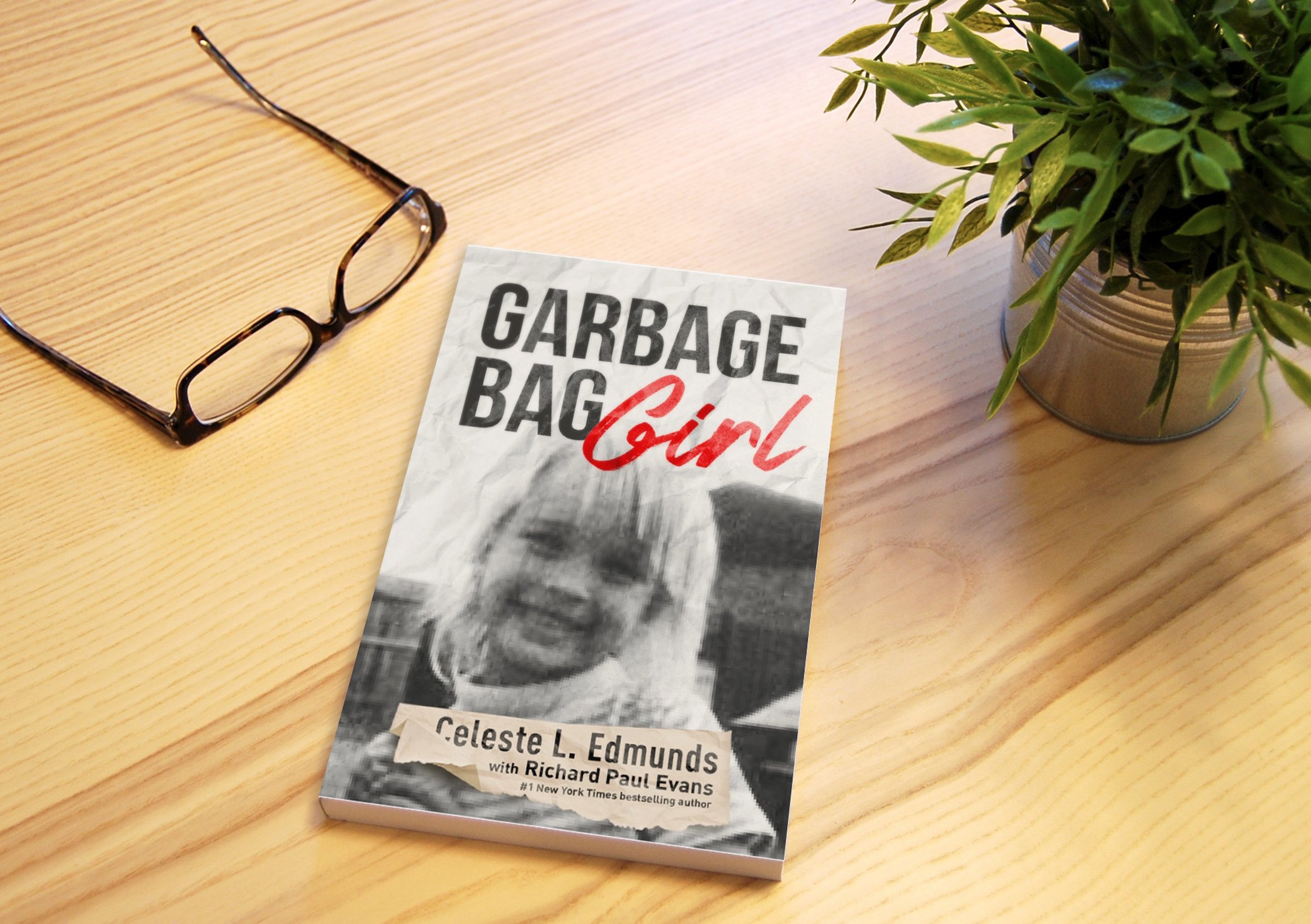
She named it Garbage Bag Girl, for the bag that held all she had.
Her dedication reads:
“To my mom, Carlie. Thank you for truly giving me life.”
Now a book, it inspires donations to The Christmas Box International, the shelters’ funding lifeline.
Celeste serves as Executive Director, helping to keep nearly 1,000 siblings together every year.
The very thing no one did for Celeste, Tawny and Austin.
Children arrive with only the clothes on their backs. They leave with everything new, packed in a duffle bag or backpack they choose.
No child has ever left with a garbage bag.
They never will.
“I thought of the half a million children in the foster care system whose voices will never be heard,” Celeste says.
She published Garbage Bag Girl for them.
And for every child who still carries all they are in a garbage bag.
This story is theirs.