
DAVID DUROCHER - THE OTHER SIDE ACADEMY
Accountability
By Richard Markosian | Photography by Dung Hoang
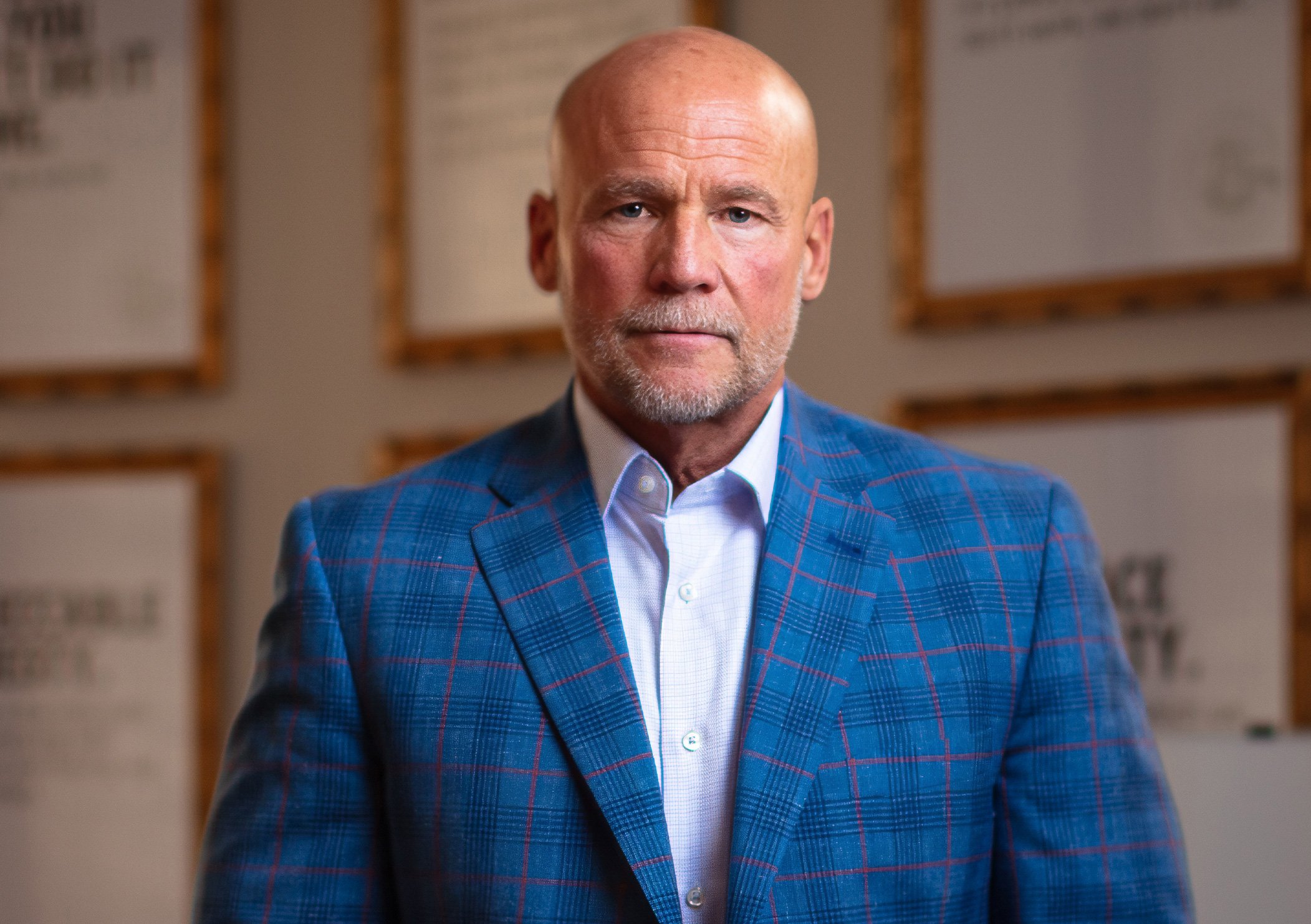
JUST OUTSIDE THE OTHER SIDE ACADEMY IN SALT LAKE CITY, a small bridge spans a narrow stream flowing through the front of the campus. Every new resident who arrives at the Academy crosses that bridge, but it represents far more than a path to the front door. It is a symbolic crossing from one life to another — from addiction to recovery, from excuses to accountability, from dependency to self-reliance, and from hopelessness to purpose.
The destination is what the Academy simply calls “the other side” — a life where people become dependable employees, loving parents, trustworthy friends, and productive members of their communities.
Few people understand the meaning of that bridge better than Dave Durocher. Long before he became COO of The Other Side Academy, he was the man lost in a criminal world. For 27 years, Durocher was evading authorities and avoiding familial responsibilities. He spent decades addicted to drugs, cycling in and out of jail and prison, destroying relationships with those he loved most and becoming exactly the kind of person society often writes off as beyond hope.
His own journey toward the other side began, not in Utah, but in a long-term therapeutic community in California. Although the program was designed to last two years, he stayed for eight-and-a-half because he realized that lasting recovery required far more than simply getting sober. Today, he leads one of Utah’s most successful long-term recovery programs, helping hundreds of men and women make that same journey across the bridge that changed his own life.
Durocher doesn’t romanticize his past or search for excuses. He speaks about it with an honesty that immediately commands respect. “I had wives, but I was never a husband,” he told me. “I have three kids. They are all now in their late 30s and early 40s. I was never a dad.”
Rather than blaming his childhood, society or circumstance, he accepts responsibility for the damage he caused. “Every single bad thing that ever happened in my life was my fault,” he said. “Everything good that’s happened in my life in the last 21-and-a-half years is my fault.” That radical ownership of his own decisions became the first step toward rebuilding his life.
The years Durocher spent in California reshaped the way he understood addiction. Detoxing from drugs was only the beginning. The far more difficult task was replacing decades of dishonesty, manipulation, irresponsibility and self-destruction with habits of discipline, accountability and service.
“People have been clean and sober 40 times already,” he said. “Getting clean and sober is not enough. They haven’t learned to tell the truth, to be accountable, to be responsible, to have integrity, to do the right thing, to show up, to put others first.” Recovery, he concluded, was not measured in days of sobriety, but in years of becoming a different person.
Those lessons became the blueprint for The Other Side Academy. Unlike virtually every traditional treatment provider in Utah, the Academy does not rely on government operating funds. Residents work in social enterprises that generate the revenue needed to sustain the organization while simultaneously learning how to become dependable employees and productive citizens. Durocher believes work is not punishment but restoration.
Every day, residents practice showing up on time, accepting feedback, solving problems and becoming people others can trust. By the time they graduate, employers across Utah actively recruit them because they have demonstrated something many treatment programs never have: the opportunity to teach consistency over years, not weeks.
Durocher is careful not to criticize the thousands of compassionate people working in nonprofit organizations. Instead, he questions the incentives behind many publicly funded systems. “It’s not the people,” he says. “The model’s broken.” In his view, too many organizations become consumed with securing the next grant or appropriation rather than measuring whether the people they serve ultimately become independent.
Too often, the duration of treatment is dependent upon funding rather than efficacy or actual behavioral change. The result, he argues, is a revolving door that cycles people through detox centers, emergency rooms, shelters, jails and publicly funded programs without ever addressing the behaviors that led them there in the first place.
Perhaps Durocher’s most controversial belief is that compassion without accountability ultimately becomes its opposite. He worries that many well-intentioned policies unintentionally remove the incentives people need to change. “If you incentivize change, people change,” he told me. “If you disincentivize change and make it easy to continue using, why should I change?”
Whether readers agree with every conclusion or not, his perspective deserves careful consideration because it is rooted in lived experience rather than academic theory. He knows what it means to manipulate systems, avoid responsibility and blame everyone else because he once did exactly that.
The Academy’s graduates provide perhaps the strongest evidence for Durocher’s philosophy. By the time they leave, many are managing businesses, working in public service or supporting families of their own. For Durocher, the goal has never been to create lifelong clients of a social service agency. The goal is to help people become independent citizens who are no longer dependent upon taxpayer support.
America today is at a critical juncture in how it approaches welfare, homelessness, addiction and criminal justice. Government spending on social services continues to grow while federal deficits have reached unprecedented levels, raising difficult questions about whether our current approach is producing lasting solutions or simply managing an ever-expanding crisis.
During the 1990s, America faced a similar moment of reckoning. Republicans led by Newt Gingrich, and Democrats led by President Bill Clinton, came together to reform welfare around a simple principle: public assistance should encourage work, personal responsibility and independence whenever possible.
While politicians continue to debate every aspect of those reforms, they reflect a bipartisan belief that the purpose of public assistance should be to help people regain self-sufficiency rather than remain dependent upon government support.
Three decades later, Durocher’s life invites us to ask whether it is time for another bipartisan conversation — one informed by people with lived experience who understand what truly changes lives rather than simply what sustains systems.
Dave Durocher crossed his bridge many years ago. Today, he spends his life inviting others to cross theirs. His transformation did not begin when someone lowered expectations for him. It began when a community demanded more from him while refusing to give up on him. The Other Side Academy has built its model around that same conviction, producing graduates who don't rely upon government or charity, but accountable workers, taxpayers, parents and neighbors. America does not lack compassionate people, nor does it lack resources. What it lacks is the courage to build systems that expect people to rise.
If leaders are serious about reforming welfare, poverty and criminal justice in the years ahead, they would do well to listen to people like Dave Durocher — men and women whose lived experience reminds us that the people are not broken. The model is.