
DR. DAVID BEARSS
Utah Life Sciences
By Tani Knight | Photography by Dung Hoang
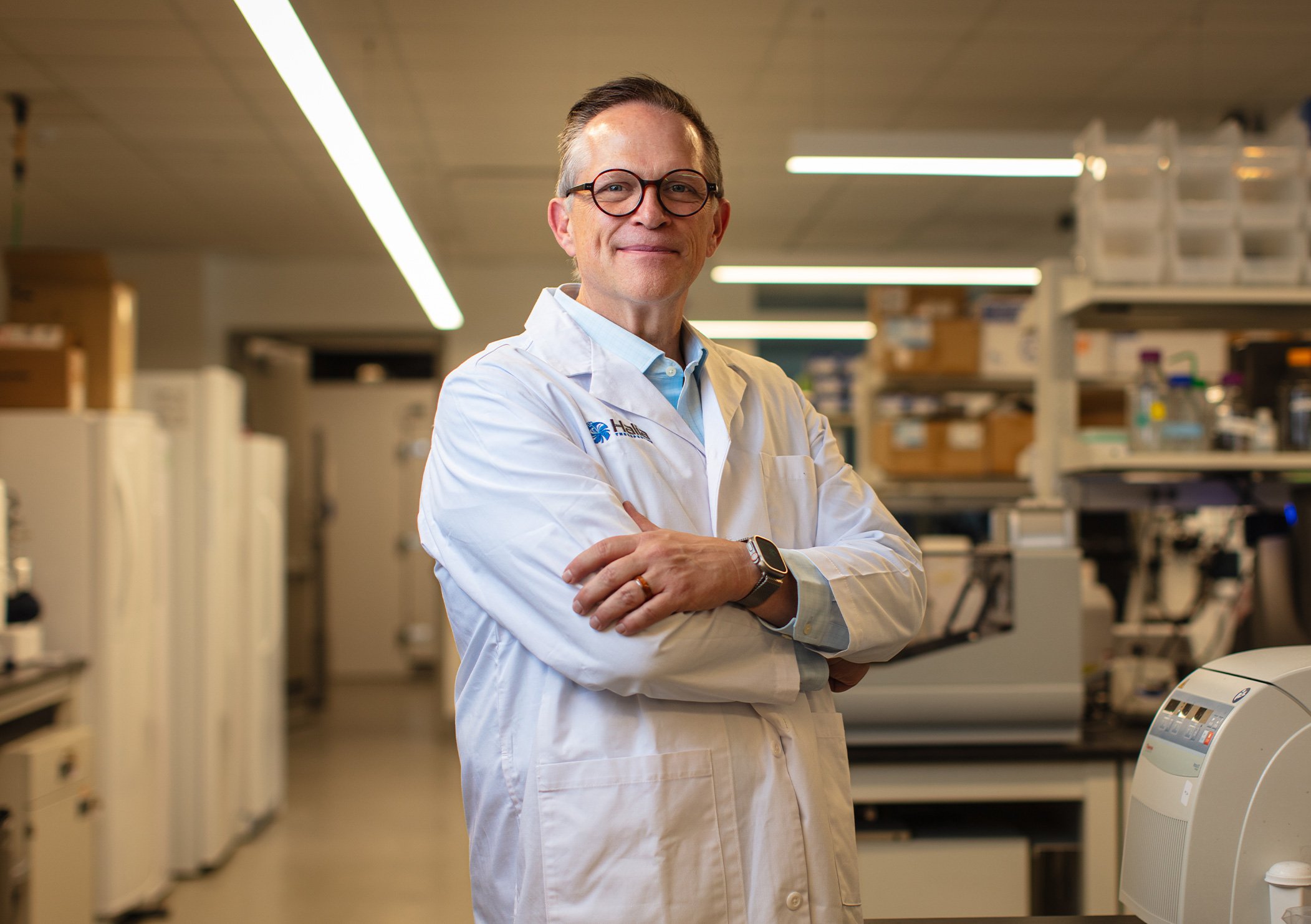
A DUSTY BLACK AND WHITE PHOTOGRAPH IS THE CLOSEST DR. DAVID BEARSS EVER CAME TO KNOWING HIS GRANDFATHER. In it, Bearss is an infant in his grandfather’s arms — the only image he has of a man he never got to know. His grandfather died of colon cancer the year Dr. Bearss was born. Years later, cancer would take his mother as well. So, when Dr. Bearss talks about cancer, he is not speaking only as a scientist or entrepreneur. He is speaking as a grandson and a son, shaped by losses that helped define his life’s mission.
By the time he was a teenager, that family history had begun to take the shape of a question — one that would stay with him for decades. "Wouldn’t it be cool if I could work on cancer and cure cancer and make somebody else's grandpa stay around?" Dr. Bearss recalls thinking.
That simple question did not become a fully formed career plan overnight. But it gave him an early sense of direction, one that would grow stronger as science became a constant presence in his life and cancer became a problem he wanted to understand at its roots.
A Childhood Surrounded by Science
Born in Utah and raised in Washington State, Dr. Bearss grew up in a family where scientific discovery was part of everyday life. His father, a chemist with a Ph.D., frequently worked in laboratories, exposing Bearss to research from an early age. Watching experiments unfold sparked his curiosity, but the loss of family members to cancer gave that curiosity a deeper purpose.
When he arrived at Brigham Young University, he initially followed in his father's footsteps by studying chemistry. It did not take long, however, for him to realize his interests lay elsewhere.
“I wanted to understand the biological basis of disease,” he says.
That desire eventually led him to earn a doctorate from the University of Texas and begin a career focused on understanding what goes wrong inside the human body and how those problems might be corrected. Along the way, he became increasingly interested in how scientific discoveries move from the laboratory to actual patients. One challenge stood out to him early in his career: many of the tools’ researchers relied on to predict whether a treatment would work in humans were far from perfect.
Like most cancer researchers, he spent years working with animal models. While those studies are an important part of drug development, he came to recognize their limitations.
“We don’t have great models and that's been the real challenge,” he says. “We use animals to try to model what happens in people, but animals are not people. They may share some common biology but they’re not just small people, right? The mouse is not a small furry person; it has a very different physiology and biology.”
Many therapies that appeared promising in animals failed once they reached human trials. Researchers could spend years developing a treatment only to discover that the biology of a mouse did not accurately reflect the complexity of human disease.
That realization reinforced his belief that scientists needed better ways to understand cancer and evaluate potential therapies. It also helped shape his approach to research and drug development, pushing him to focus on the underlying biology of disease rather than relying solely on traditional models.
The Entrepreneur He Never Planned to Become
His original vision was to become a researcher and professor. He eventually achieved that goal, building an academic career while conducting research and teaching students. Yet he soon discovered a frustrating reality: scientific discoveries made in universities rarely become treatments on their own.
Universities often uncover the biological pathways that cause disease, but turning those discoveries into medicines requires companies willing to invest years of effort and enormous financial resources. If he wanted to see his work reach patients, he realized he would need to leave the traditional academic path. That decision launched him into entrepreneurship. What followed was a crash course in fundraising, leadership, and risk-taking — skills he never expected to need.
“I never really wanted to be an entrepreneur,” he says. “I never took a business class in my life. Then all of a sudden, I find myself having to go out and raise money and convince people to invest in the company.”
To bring discoveries from the laboratory to patients, Dr. Bearss realized he would have to build companies capable of carrying promising therapies through the long and expensive drug development process. In 2003, he founded Montigen Pharmaceuticals — one of the first biotechnology companies in Salt Lake City.
The company was later acquired by SuperGen, launching a career that would see him found and help lead multiple Utah biotechnology companies, including Tolero Pharmaceuticals, Salarius, and Halia Therapeutics. Along the way, he learned that entrepreneurship wasn't separate from science — it was the bridge that allowed science to reach people.
Building Hope in an Industry Defined by Failure
Drug development is among the most difficult endeavors in modern science.
More than 95 percent of drugs that reach clinical testing ultimately fail. Countless others never make it that far.
Part of that challenge stems from the limitations Dr. Bearss observed throughout his career. Researchers can generate encouraging results in laboratories and animal studies, only to discover that human biology responds very differently. The gap between promising science and successful medicine is often much wider than people realize. For Bearss, setbacks are not occasional obstacles, they are part of everyday life.
“You get bad results and it's like, now what do you do?” he says.
Despite the challenges, he has remained committed to the mission that first inspired him as a teenager. Over the course of his career, Dr, Bearss has helped advance 18 drug candidates into human clinical trials — an achievement he notes is uncommon in his field.
“Most scientists never see even one of their molecules reach a patient,” he says.
Several therapies he helped develop have gone on to reach patients, but one moment stands above the rest. A drug he worked on was eventually approved and later used to treat his own father-in-law after he was diagnosed with acute myeloid leukemia.
“Having something I helped create actually reach a member of my own family was one of the most profound moments of my career,” he says.
For Dr. Bearss, that experience became deeply personal proof that years of research, failed experiments, fundraising, and perseverance could ultimately change lives.
Helping Build Utah’s Biotechnology Ecosystem
When Dr. Bearss founded Montigen Pharmaceuticals in 2003, Utah’s biotechnology industry was still in its infancy. Companies with ambitious drug-development programs often gravitated toward established hubs like Boston or the San Francisco Bay Area, where investors, experienced executives, and pharmaceutical partners were easier to find.
“Back then we were kind of all by ourselves,” he says.
Rather than leave Utah, Dr. Bearss chose to help build the industry where he lived.
After Montigen was acquired by SuperGen, he continued launching companies from discoveries made at the University of Utah and the Huntsman Cancer Institute. Those companies included Tolero Pharmaceuticals and Salarius, each focused on translating scientific discoveries into new therapies.
One milestone stands out. When Tolero Pharmaceuticals was acquired by Sumitomo, the transaction became one of the largest deals in Utah life sciences history. Beyond the acquisition itself, the partnership encouraged the Japanese pharmaceutical company to establish a presence in Utah — bringing additional investment, talent, and opportunity to the state's growing biotechnology sector.
For Dr. Bearss, building companies has never been solely about business success.
Starting biotechnology companies has created jobs, kept scientific discoveries in Utah, and demonstrated that world-class medicines can be developed without relocating to the coasts.
His influence also extends into education and mentorship. Throughout his career at Brigham Young University, the University of Utah, and the Huntsman Cancer Institute, he has trained more than thirty graduate students and roughly as many postdoctoral fellows. Many have gone on to careers of their own in biotechnology and academic research.
Today, Dr. Bearss continues helping shape the state’s future as a member of the BioUtah board, supporting the growth of Utah’s broader life sciences community.
“It’s kind of fun when people say, ‘You helped build this,’” he says.
Still, he does not describe himself in grand terms. Ask what he does outside of work, and he laughs about how closely his personal interests resemble his professional life.
“My hobby is reading scientific papers,” he says. “I actually enjoy it.”
But science is not the whole of who he is. He also talks with obvious affection about his family — six grown children and seven grandchildren — and the time he spends with them. In many ways, the mission that began with the grandfather he never knew has come full circle in the family he now treasures.
Looking Toward the Future
Recently, Dr. Bearss returned from Europe, where his company presented promising results from a clinical trial involving patients with a serious blood cancer. The moment represented years of work transformed into something tangible — an idea becoming a potential therapy. Yet even after decades of accomplishments, he remains focused on what comes next.
He believes advances in artificial intelligence, biology, and medicine will dramatically improve human health over the next twenty years. He is particularly optimistic that new technologies will help researchers better understand human disease and reduce some of the uncertainty that has long plagued drug development. Better models, better data, and more precise treatments could help scientists identify successful therapies faster and avoid pursuing approaches that are unlikely to help patients.
His vision goes beyond simply helping people live longer. Instead, he hopes future generations will remain healthier later in life, adding years of vitality rather than years of illness.
“I really believe in the next 20 years we’re going to add ten years of health to everyone’s life,” he says.
If that future becomes reality, more people will know their grandparents. More families will have additional years together. For a scientist whose life’s work began with the memory of a grandfather he never knew, the greatest measure of success is no longer found in companies founded, awards received, or drugs advanced into clinical trials. It is found in the families who have been given more time together, including his own. The teenager who once wondered if he could help someone else’s grandfather stay around has spent a lifetime doing exactly that.