
ENTERPRISE
By Richard Markosian | Photography by Dung Hoang
JOHN PRINCE
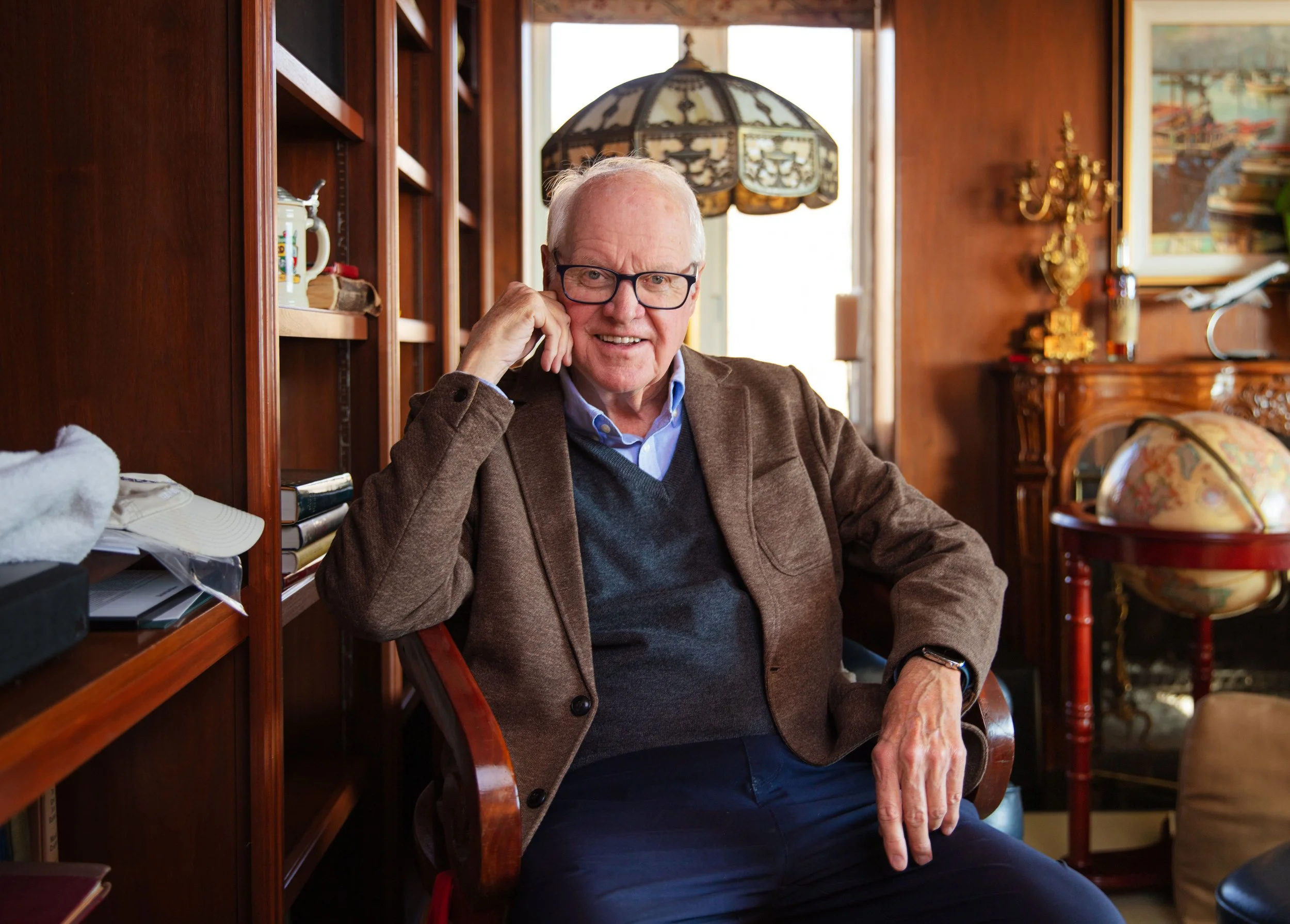
JOHN PRINCE’S EARLIEST MEMORIES of downtown Salt Lake City start with his mother’s gloves.
“You’d go downtown,” he remembers, “and my mother would put gloves on, and then you’d be in the car. And in Auerbach’s, there’d be an elevator, and somebody would be, you know, ‘Third floor, lingerie’ — that was the one that always made me smile when I was 11 years old.”
John was born in 1941, but his real memories of Salt Lake City began in the 1950s, when downtown was the unquestioned center of life.
“ZCMI was our go-to for everything up on Main,” he recalls. “But all of the retail, as I remember it, was just spread out along the streets. Main Street, and then Exchange Place, was a major shopping district.”
He ticks off names like an incantation: Pearsall’s for jewelry and repairs. Hibbs Clothing. Makoff’s, “which we thought was a department store.” Auerbach’s near Third South. Broadway Shoes on Third South, with the animated cobbler in the window pounding a nail into a shoe. “You’d go in there and have that marvelous shoe smell,” he says.
A Small Town Disguised as a City
What John remembers most about those early years is how personal everything felt.
“I think everything was locally owned at that time,” he says. “My parents knew the owners.”
Downtown felt both local and intimate. You knew who owned the store. You knew who ran the bank. Continental Bank stood where the Monaco Hotel is now, and when you walked in, it felt like a church to money.
A Gentler Divide
For a boy growing up in the ‘50s, the famous Mormon–Gentile divide of Main Street wasn’t something John consciously felt, at least not through the doors of local businesses. In downtown, the divisions blurred.
“Everybody was sort of mushed together. I get the sense the Mormons are more Mormon now than they were back then.”
The Mall Era: When Modernity Moved the Crowd
By the late 1960s, suburban shopping centers and national brands were starting to pull customers away from Main Street.
“Had I been reflective, I probably would have noticed it sooner,” John admits. “I’m sure there were people who said, ‘When Crossroads Mall gets built, it’ll destroy the rest of downtown.’ I’m sure nobody listened. And it happened.”
Cottonwood Mall in Holladay, Kmart up near Parleys, Payless Shoes — each new arrival drew cars and customers that might once have gone to Main Street.
When Crossroads Mall opened downtown, John and his wife embraced it like everyone else.
“We thought Crossroads was just everything,” he says. “We thought all shopping would go there — and for a while, all shopping did go there.”
John and his family became part of that transition. His wife opened a store in Crossroads called Pamela’s, a kind of early Martha Stewart-style lifestyle shop with frames, place settings, and carefully curated home goods.
Meanwhile, John opened a hamburger joint in the food court with the unlikely name of Watney’s.
“I have no idea how we came up with such a lame name,” he laughs. “But we did one thing: we took mustard, mayonnaise, and ketchup, mixed it together, and just stuck it on every burger.”
Watney’s eventually sold and became an A&W. The brands were arriving, and downtown — like the suburbs — was now defined as much by logos as by local names.
Bars, Brands, and the Afterlife of Downtown
As the decades rolled on, John’s life followed the same currents that were reshaping Main Street and the suburbs. He bought the Ponderosa Steakhouse franchise for Utah. Later, he helped bring Applebee’s to the state just as “neighborhood “bar & grill” chains became the new middle-class ritual.
Yet even as the malls drew shoppers inward and the big chains multiplied, the social life of downtown found new homes — in places like Trolley Square, which became a historic hub with a modern flair.
Green Street at Trolley Square became one of those hubs. John took it over when the former owners had to divest. It was there that he met Jason LeCates, who’d later become a partner at Whiskey Street.
Trolley Square eventually declined. The rent for Green Street climbed to astronomical levels and the numbers just stopped working. “You think you own something,” John says, “but the day the lease runs out, you’re not an owner anymore.”
Yet even in that ending, downtown’s next chapter was already forming. A chance meeting with Jason LeCattes, a new partnership, and eventually, Whiskey Street, part of a new wave of bars and restaurants that would breathe life back into the old spine of the city.
A Street That Keeps Becoming
John’s life traces the arc of Salt Lake City’s Main Street: from local owners and scattered storefronts, to malls and national brands, to bars, nightlife, and urban revival.
Ask him today what he remembers most, and he doesn’t start with the big developments. He goes back to the small, specific details: the animated cobbler in Broadway Shoes’ window, the hush of Continental Bank’s carpet, the elevator operator at Auerbach’s calling out “Third floor, lingerie,” while an 11-year-old boy struggled not to giggle.
It was, as he puts it, “a small town, starting to be a little bit of a town.”
Main Street has changed beyond recognition since then — rebuilt, burned, redeveloped, glossed over, and revived again. But in John Prince’s memories, you can still walk the whole length of it: past the old local shops, through the malls that replaced them, into the bars and restaurants that came later, all the way to the present moment, where the city is once again trying to decide what kind of downtown it wants to be.
FACES of Utah profiles the leaders and change makers shaping our state.
Recognized for your impact?
[ Request Media Information ]