
Main Street
How We Traded Our Local Character for Corporate Convenience — and Why a Fire Might Yet Spark a Revival
By Richard Markosian
The Night Main Street Burned
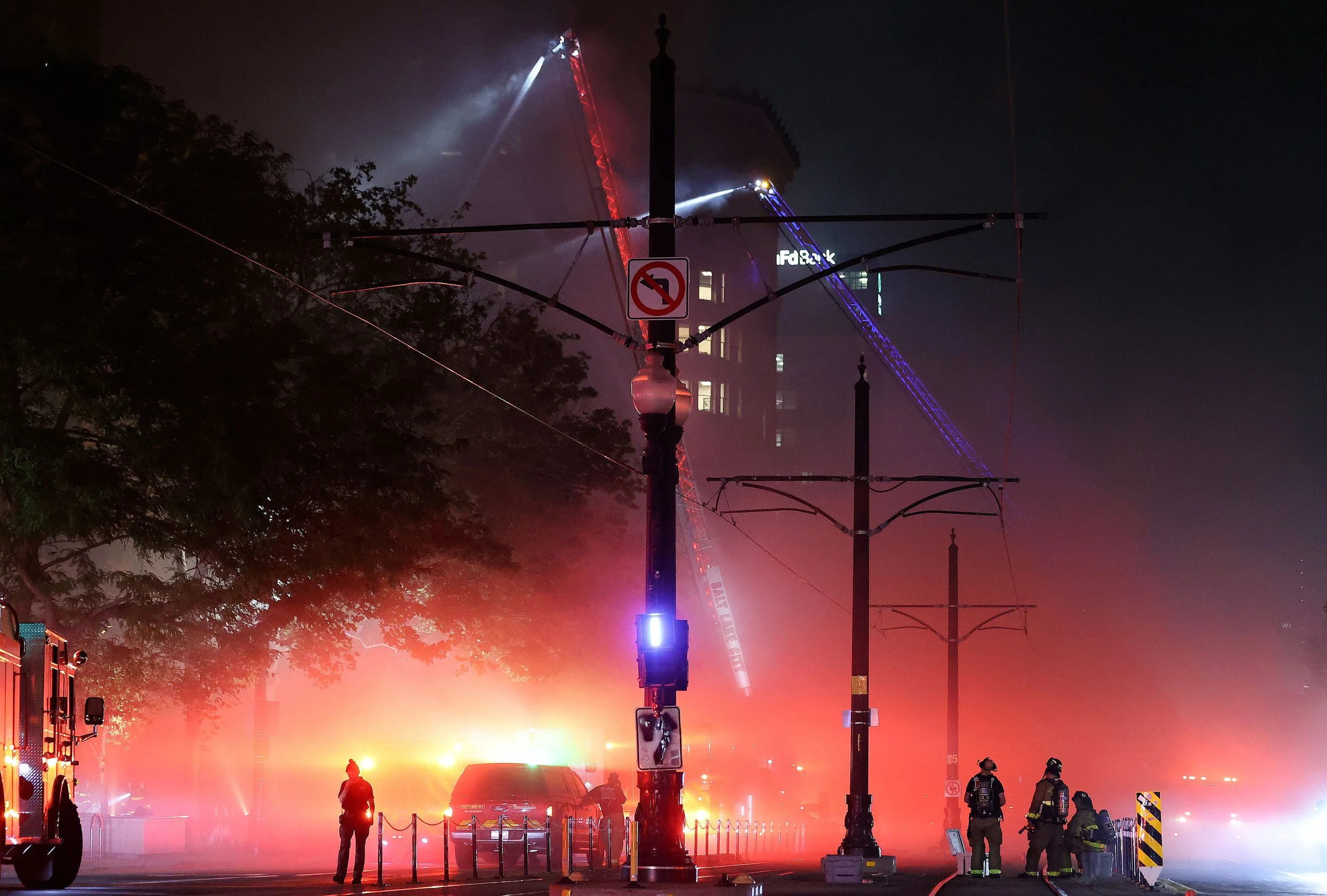
On the night of August 11, 2025, downtown Salt Lake City felt alive in the way it often does in late summer. White Horse was full. Whiskey Street was buzzing. London Belle was midway through its supper rush. Los Tapatios was humming along next door. It was the kind of night that had, over the past decade, become emblematic of a downtown that had regained a pulse.
Then smoke began leaking from London Belle’s kitchen.
Within minutes, it became a plume. Flames crept upward into the ceiling cavity — the narrow, hidden space between old brick walls and ancient timber. These historic structures shared their walls like rowhouses; once fire found its way into that upper void, it traveled fast. By the time the first fire crews arrived, the blaze had already jumped into Whiskey Street and began curling under the roof supports of White Horse.
Jason LeCates was called from his home in Ogden Valley by his partner Trace that there was a fire next door. He watched the scene begin to unfold through the restaurant’s security camera feed. At first he saw only a vaguely smoky haze near the back bar. A few guests drifted toward the doors — an inconvenience, he assumed — nothing more serious than a small disruption. Then the screen went gray. Smoke swallowed the frame. Suddenly there was nothing to see but a wash of white fog.
By the time Jason reached downtown, Main Street was sealed off. Fire engines flanked the block, firefighters attacked the blaze from above and below. “You could hear bottles blowing up inside.” Trace Hagemann tells me. He showed me a video on his phone of flames shooting out an upper cavity of the building as each “boom!” is followed by a burst of flame. Dozens of bottles of high-proof liquor were exploding.
Three firefighters would be injured that night; one trapped briefly under debris. No civilians were hurt.
Examining the damage the next morning, the block looked like a war zone. The charred bones of four beloved businesses — London Belle, Los Tapatios, Whiskey Street, and White Horse were tilting under a haze of steam. The whiskey wall that had become an unofficial cultural landmark was reduced to charred bottles and empty, blackened glass. Floors collapsed. Ceilings peeled downward like scorched petals. The entirety of Whiskey Street — arguably the most iconic bar in Utah — was now a ruin.
News outlets did not exaggerate. They called it a “massive Main Street fire,” a “heartbreak on Whiskey Street.” Those descriptions captured the emotion of a city that suddenly realized what it had nearly lost: not just a bar district, but a story about its future.
Salt Lake City mobilized quickly. Mayor Erin Mendenhall stood at the cordon and promised support. The Downtown Alliance revived its “Tip Your Server” emergency fund from the pandemic years. Donations surged. Competitors held benefit nights. Residents gave whatever they could. Within days, tens of thousands had been raised; within weeks, the fund climbed toward half a million dollars, supporting more than two hundred displaced workers.
Standing near the ruins, Jason said what many were feeling: “If you came down here on a Friday or Saturday night, this was the heart of the city. Right now the vibe just isn’t there.” But he added something else — something that sounded less like optimism than resolve. “Trust us that we intend to rebuild. We’re not going to let this go away over a fire.”
The fire was a tragedy. But it also served as a lens — revealing, in one night, how deeply Main Street mattered to Salt Lake City. To understand why the loss of four businesses on one August night hit so hard, you have to go back in time—long before vodka cocktails and whiskey flights—to an era when the city did not simply “have” a Main Street; it lived on one.
When Main Street was the City’s Living Room
Long before chic cocktail bars appeared along the 300 South block, before the streetcars vanished and returned in the form of TRAX, before the malls rose and fell, Main Street was where Salt Lake City gathered to make sense of itself.
In the late nineteenth and early twentieth centuries, the stretch between 100 South and 400 South was known, with no small irony, as Whiskey Street — a row of saloons and billiard halls that Brigham Young strongly discouraged his followers from visiting. Despite the admonitions, or maybe because of them, the area thrived. It was a raucous borderland where cultures met: railway workers, miners, immigrants, cowboys, merchants, schoolteachers, farmers, and wanderers all shared the same sidewalks.
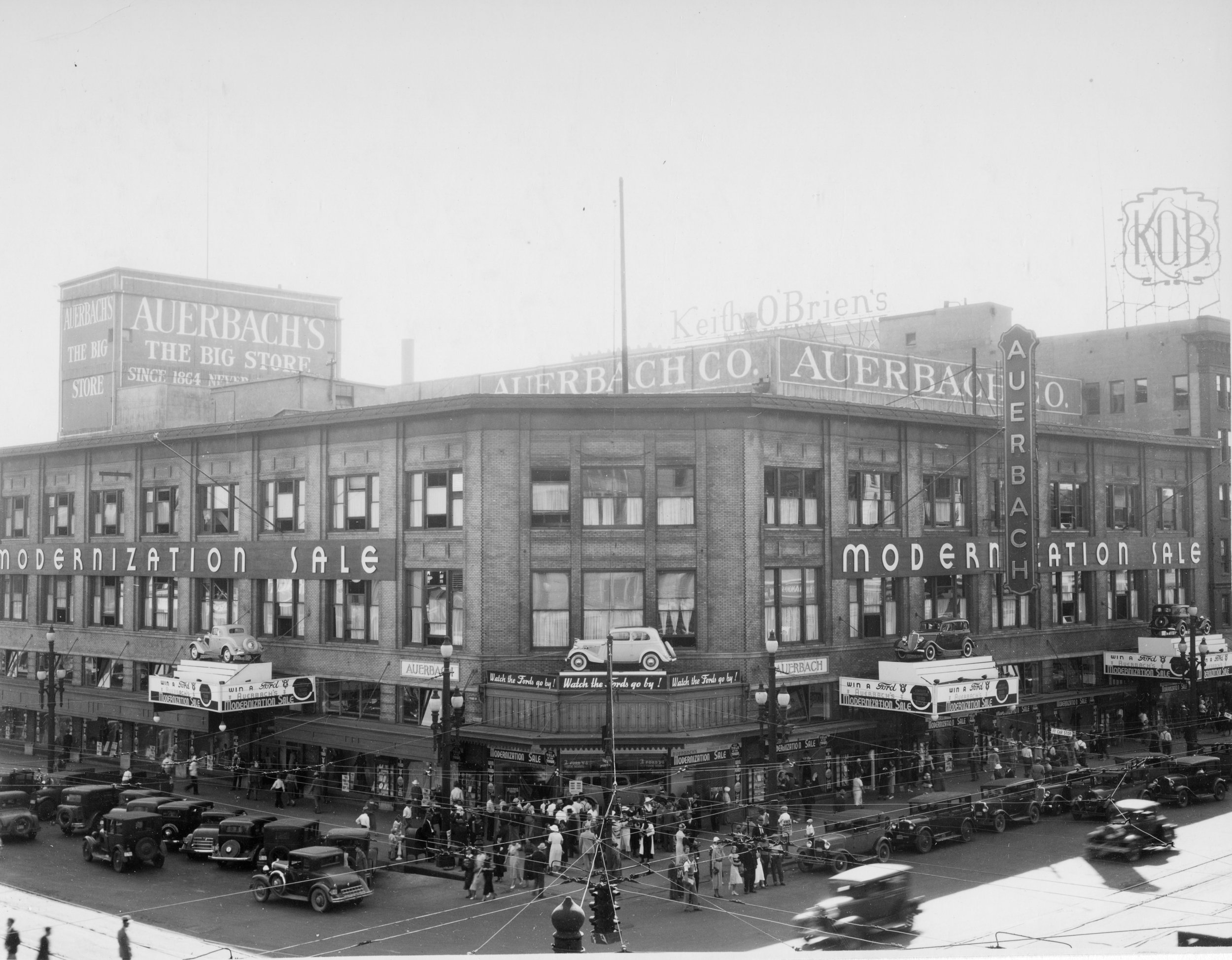
But beyond the saloons was a dense fabric of locally owned businesses. The Shipler photographic archives, which I first explored more than a decade ago, show Main Street alive with theaters, tailors, barbers, haberdashers, jewellers, candy shops, tobacconists, book sellers, grocers — even an enclave of Chinese businesses near Plum Alley that survived into the early 1900s. These photos capture a street pulsing with commerce, conversation, and cultural exchange.
One Shipler image shows hundreds of people crowding outside the Deseret News building during the 1942 World Series, (before television was in most homes) watching the game on a giant scoreboard lit with electric bulbs. Vendors sold hotdogs through the throng. Newsboys darted between adults. Children perched on lampposts. For an afternoon, Main Street became a stadium and a community square — a place where strangers discovered themselves to be neighbors.
In that era, “economic development” required little more than a storefront and a willingness to work. You didn’t need a feasibility study or a tax increment incentive. You didn’t need a corporate landlord or a national chain affiliation. You rented a narrow shop, hung a shingle, and you joined the street’s conversation.
It wasn’t utopia. It wasn’t without prejudice or exclusion. But it was walkable, dense, local, and entrepreneurial — a self-sustaining ecosystem of small businesses whose survival depended on one another. That version of Main Street lasted for almost a century.
Its unraveling began slowly, almost imperceptibly, and then all at once.
From Streetcars to Malls: The Long Unraveling
What happened to Main Street after World War II mirrors what happened in almost every American city. The streetcars disappeared. Freeways arrived. Suburbs proliferated. And everyday life shifted away from the sidewalk and toward the automobile.
Salt Lake City embraced this new model enthusiastically. In 1962, the Cottonwood Mall opened — the first fully enclosed regional mall west of the Mississippi. It felt like the future: climate-controlled shopping, endless parking, escalators, fountains, Woolworth’s, JCPenney, national brands that signaled the arrival of modern retail. Families flocked to it.
Downtown leaders watched the exodus and responded by building inward. The Crossroads Plaza and the ZCMI Center emerged in the 1970s, marketed as antidotes to suburban flight. In many ways they were successful — they brought people downtown. But unlike the Main Street storefronts that faced outward, the malls turned their backs to the street. Shoppers parked in garages, entered through internal corridors, and could spend an entire day inside without once touching Main Street’s sidewalks.
When I interviewed Bart Stringham, third-generation owner of Utah Woolen Mills, in 2010, he explained the paradox with painful clarity. The malls, he said, were “good for downtown” — they brought customers back. But they did so in a way that starved the smaller shops around them.
“If you weren’t in Crossroads or ZCMI Center,” he told me, “you were probably going under.”
His family’s business had survived since 1905, outfitting miners, missionaries, and businessmen alike. But even Utah Woolen Mills could not escape the gravitational pull of enclosed retail. Foot traffic outside the malls thinned. Independent shops closed. Downtown became increasingly bifurcated — vibrant inside the malls, hollow outside them.
The arrival of the freeways only amplified the pattern. Families who once took the streetcar downtown for a Saturday outing now merged onto I-15 and I-80, heading for newly built shopping centers in Murray, Sandy, Bountiful, and Ogden. Suburban convenience replaced urban necessity.
By the 1990s, Main Street had become something it had never been before: optional.
The Wellers Leave Main Street
If any single business embodied the old Main Street spirit, it was Sam Weller’s Zion Bookstore. Its Main Street location was a labyrinth of aisles, nooks, rare volumes, mezzanine galleries, and creaking floors that seemed to hold the intellectual memory of the city. You didn’t just shop there; you wandered, you paused, you stumbled upon ideas you weren’t looking for.
But by the early 2000s, conditions around the store deteriorated. The construction of the TRAX line posed severe challenges. Long stretches of Main Street were torn up, rerouted, fenced off. For months at a time, customers struggled to reach the shop. At the same time, the city’s approach to homelessness shifted. Police enforcement grew inconsistent, and merchants increasingly felt that the city prioritized tolerance of disorder over the economic viability of long-time businesses.
The Wellers, reluctant to abandon their legacy but increasingly cornered by circumstance, made the decision to move to Trolley Square in 2012. There, the historic barns and brickwork still supported the kind of serendipitous browsing and human-scale retail that had defined their Main Street years.
When I later spoke with Katherine Weller in the quiet reading room in their store, she articulated the change bluntly.“Main Streets are now for banks and bars, not for retail,” she said.
Her daughter Lila offered a counterpoint:
“Gen Z cares more about experiences than material things. That’s why we like local shops and walkable streets. We’re not just buying — we’re looking for something real.”
Between their two perspectives lay the story of Main Street’s slow transformation — and the faint outlines of how it might rise again.
The Merchants Who Refused to Leave
Twenty years ago, when Utah Stories began interviewing downtown merchants, the long-time characters who could recall Main Street’s history were still plentiful. Today, Ken and Pete are downtown’s living historians and librarians. But the merchants of the early 2000s were all characters. Tom Warner of L. Lorenz knife shop; Bill Bennion of Bennion Jewelers; and John Speros who worked at Lambs Grill Cafe for 56 years. Speros began working at Lambs as a boy, then eventually bought the restaurant and building with his brother. Speros decided to finally retire in 2012, and he sold off the business, which eventually went under after the new owner failed to secure their liquor license.
Their stories are too numerous to tell individually, but collectively they underscore a point often missing from policy discussions. When a city favors mega-projects and corporate tenants in the name of economic development, it often does so at the quiet expense of the people who had been investing in that city all along.
The survival of a bookstore or a kilt shop rarely makes the news. The demolition of an old building for a tower or a parking lot almost always does.
And yet, it is the survival of those smaller enterprises that gives a place its soul.
Even as Main Street lost some of its foundational shops, others dug in with stubborn resolve. Among the most steadfast was Ken Sanders, the rare-book dealer whose shop on 300 South became a sanctuary for poets, collectors, musicians, eccentrics, and anyone hungry for the kind of atmosphere that cannot be mass-produced.
Ken’s store was a bridge between eras — a living reminder that the literary counterculture of the 1970s and 1980s never entirely vanished; it merely needed a place to persist. In a city where demolition outpaced memory, Ken held on. He hosted readings, concerts, lectures, and community gatherings. He resisted the notion that bookstores were obsolete.
But even his resilience had limits. After roughly 30 years in his Broadway location redevelopment pressures forced Ken to move. He relocated to the old Leonardo Building — formerly the library and later the home of the Salt Lake City Winter Market. The building offered lower costs and room to breathe. His departure from Broadway was yet another warning sign: when even the city’s most beloved independent merchants can no longer afford to stay, something in the ecosystem has gone wrong.
Other merchants weathered their own storms. Jewelers who had been in business for generations fought declining foot traffic. Import stores scraped by selling items that could now be purchased online in seconds. Old diners struggled against fast-casual chains. Some survived by sheer force of will; others relocated to Sugar House, 9th & 9th, or Murray to find better rent and more receptive street life. But the recurring story after Weller’s left was that homelessness was wreaking havoc on the businesses ability to attract customers. The block that Weller’s occupied became a black hole: nobody could survive what should have been the prime location of 200 South Main. Southam Gallery closed and moved to Cottonwood Heights after 30 years on Main Street. Mid City Salon joined Wellers in Trolley Square after owner Teressa Bowman told Utah Stories that the city leaders had no regard that homeless men were masterbating in her window in front of her stylists.
Homeless day campers were a fixture and shoppers stayed off Main for fear of being accosted, and the city was doing little to nothing to resolve the problem.
Still Main Street has always been a mixed bag. Neumont University, a private computer science school thrives there, as does Keys on Main, Eva Bakery, The Bar Down Under, Beerhive Pub, and the Lady Bag shop. Still, over the past two decades, the story in general has been one of declining local shops, misplaced city priorities, and failure to listen to business owner’s needs.
Main Street did not die from lack of effort. It died from a thousand small cuts — policy decisions, shifting consumer habits, inattention to street-level vitality, and the gravitational pull of corporate models that siphoned energy away from independent enterprise.
But if there was a chapter of revival ahead, it began with a group of restaurateurs who saw possibility where others saw decline.

Rebirth on a Boarded-Up Block: The Whiskey Street Era
Before Whiskey Street was a cultural landmark, it was a derelict space. In 2010, Jason LeCates and Trace Hegemann stepped inside what had once been A.J.’s Deseret Lounge and found a cavern of neglect. Pigeons fluttered between exposed beams. Light leaked through gaps in the brick. The building looked ready to give up.
But Jason and Trace saw something else: potential.
Jason had spent years managing Green Street at Trolley Square, a bar that had once defined Salt Lake City nightlife in the 1980s and 1990s. There, he met owner John Prince, a veteran restaurateur who had owned multiple Applebee’s franchises and, later, Green Street itself. But Green Street had fallen on difficult times and had to close. In 2011, during a severe liquor license shortage, Jason and his chef-partner Matthew Crandall had completed the build-out for their first venture — Bourbon House — but could not secure the license needed to open.
One night at Dick N’ Dixie’s, Jason ran into John. The conversation changed everything. As Jason recounted, Prince looked at him and said, “You have a bar without a license, and I have a license without a bar. If we can’t figure something out, we’re the two biggest idiots on earth.” They struck a deal. Prince joined as a partner. The license moved. Bourbon House opened. Their partnership was born.
That partnership would eventually transform Main Street.
With Bourbon House established in the Walker Center, the trio turned back to the boarded-up shell of A.J.’s. They imagined a long, hand-crafted bar. A wall lined with whiskey. A menu that defied the old Utah stereotype that bars served good drinks but mediocre food. Matthew Crandall, born into the Hires Big H family and sharpened in professional kitchens like Spencer’s, designed a food program that rivaled high-end restaurants.
When Whiskey Street opened in 2013, it immediately felt different. The ceilings were tall. The lighting warm. The energy electric. It honored the building’s history while giving it new life. It proved that independent operators — given the chance — could anchor a downtown renaissance more effectively than any chain.
Soon after, White Horse opened next door. London Belle added its charm, Bodega’s speakeasy two doors down had also become a destination. The block became an ecosystem — restaurants feeding off foot traffic from bars, bars feeding off restaurants, all of them benefiting from a street life that had not existed for decades.
Salt Lake City had always “wanted to love Main Street,” Jason told me. “There just wasn’t much left to love.” Whiskey Street gave people a reason. Weekend nights were packed. Tourists sought it out. Locals treated it as a rite of passage. The 300 South block became a symbol of what Main Street could be without malls, mega-developments, or corporate planning.
It was precisely this momentum that made the 2025 fire feel like a blow to the city’s identity — not just its economy.
After the Fire: A Test of Government, Community, and Will
When dawn broke on August 12, the extent of the damage was still unclear. White Horse suffered catastrophic water and smoke damage. Whiskey Street was reduced to its brick shell. London Belle and Los Tapatios were unrecognizable. Engineers declared Whiskey Street a total loss. Rebuilding would require seismic upgrades, new systems, and clearing the site down to bare dirt.
Yet amid the devastation, something remarkable happened.
City leaders and community members moved swiftly — not with platitudes, but with concrete action. Mayor Mendenhall, standing near smoldering beams, promised assistance. The Downtown Alliance, remembering how service workers suffered during the pandemic, relaunched the Main Street Fire Fund.
Money poured in.
Competitors held fundraisers. Local residents clicked “donate” in droves. Within hours, the fund had tens of thousands. Within weeks, it approached its half-million-dollar target. More than two hundred workers — bartenders, cooks, hosts, dishwashers — received emergency support checks.
This was not corporate aid. It was neighborly aid.
But the most telling sign was this: nobody suggested giving up. Not one partner. Not one employee. Not one patron who walked past the ruins.
White Horse aimed to reopen by early 2026. Whiskey Street’s rebuild would take far longer, but Jason, Trace, Matthew, and John were unwavering. They had rebuilt Main Street once. They would do it again. Their determination echoed a deeper truth: Main Street was worth saving because it had been built by people who cared enough to fight for it.

How Cities Subsidized Big-Box Retail While Main Streets Withered
While independent merchants were improvising their way through construction closures, changing demographics, and shifting cultural winds, cities across the Wasatch Front were engaged in a very different strategy: incentivizing large-format retail at highway interchanges.
In Sandy, the sprawling Scheels store was supported by up to $55 million in tax-increment financing — one of the largest retail subsidies in Utah history. Similar packages supported Cabela’s in Farmington and other box retailers across the region.
The argument was always the same: big stores bring big returns. Jobs. Sales tax. “Destination” tourism. Anchors for future development.
But independent studies — from the Urban Institute, the Lincoln Institute of Land Policy, Good Jobs First, and numerous regional analyses — found something else. Retail subsidies rarely generate net new economic activity. They simply shift spending from one place to another. A dollar spent at Scheels is a dollar not spent at a local bike shop, ski shop, or outfitter. A gallon of gas burned driving to the suburbs is an hour not spent walking downtown.
And when the big stores close — as many eventually do — cities are left with cavernous buildings too large to repurpose and parking lots too desolate to activate.
Main Street merchants saw none of these subsidies. They saw no tax forgiveness, no multi-million-dollar incentives, no glossy presentations to city councils. They navigated the hardest parts of urban life alone — construction, homelessness, rising rents, the whims of development, the unpredictability of culture.
Main Streets did not “fail.” They were systematically out-competed by publicly subsidized alternatives.
The Survivors and Those who flourish: The Daft Block, the Beerhive, and a Scottish Outpost That Shouldn’t Exist
A few blocks north of Whiskey Street stands the Daft Block, built in 1887 — one of the architectural survivors of a bygone era. Its arched windows and Flemish-bond brickwork offer a rare sense of continuity in a city often too quick to bulldoze its past.
In 2009, Del Vance opened The Beerhive Pub inside this historic building. He leaned into its old-world charm — long wooden bar, icy beer rail, intimate lighting — and built one of the most beloved pubs in Utah. The Beerhive succeeded not because it was new, but because it was authentic. Its character could not have been fabricated in a suburban lot.
Just north of the Beerhive sits Edinburgh Castle Scottish Imports, the long-running shop founded by Eric Gilzean, a Scotsman from Aberdeen who somehow made a kilt shop viable in the middle of the American West. Pipes, tartans, clan badges, tam o’shanters — the store feels like a portal to another continent.
“It’s something that doesn’t look like it should be here,” Eric once told me, laughing. “The free enterprise system works even for Scottish people, you know?”
These small, improbable businesses — the pub, the kilt shop, the antique dealer, the bookseller — are precisely what give Main Street its identity. They occupy old buildings at modest rents, creating an urban ecology that cannot be replicated through corporate planning or speculative development. They survive because they offer something no big box ever can: surprise, personality, memory, texture, relationship.
Among them, none carries the weight of memory quite like Utah Book & Magazine and its proprietor, Peter Marshall.
Peter Marshall and the Memory Keepers of Main Street
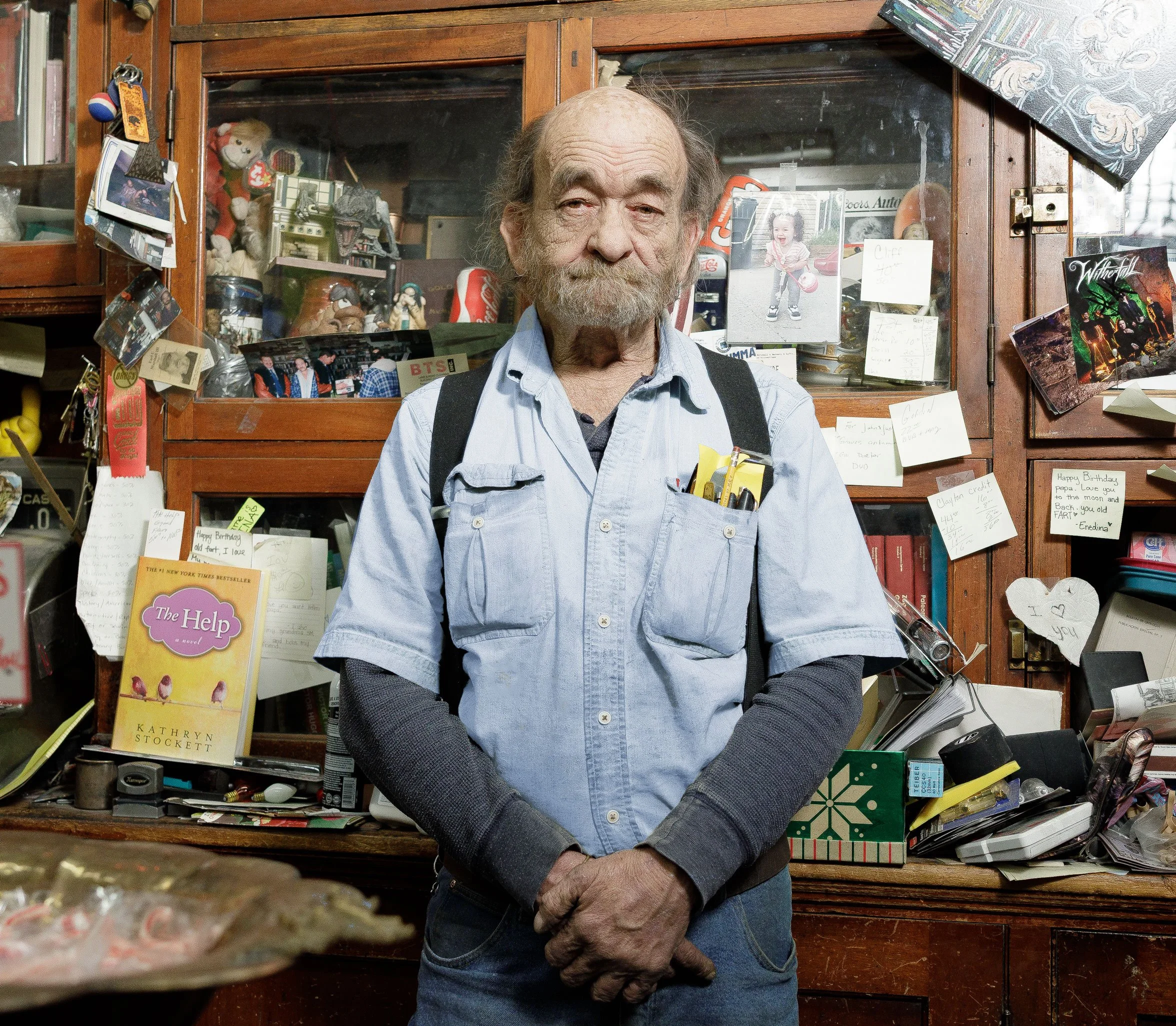
If Whiskey Street represented the new Main Street, Utah Book & Magazine represented the last living strand of the old one. Walk through its front door and you step into an earlier Salt Lake City — dusty shelves, antique curiosities, stacks of pulp novels, vintage maps, vinyl records, old postcards, Western memorabilia, and boxes of ephemera that carry the scent of entire forgotten decades. The shop looks less like a retail space than a time capsule assembled by someone who loved the city enough to save its artifacts.
That someone is Peter Marshall.
Peter has been working in the antiques and collectibles trade since age eight, following in the footsteps of his father and grandfather. His childhood was spent in and around downtown Salt Lake — its warehouses, alleys, backrooms, and basements — long before redevelopment smoothed the edges; long before most of the buildings he explored were torn down. Few people alive carry as many firsthand memories of the city’s physical evolution.
In a video interview I recorded with him years ago, Peter pointed to his holiday window display — one of the last on Main Street that still follows the old department-store tradition — and said, “I have people telling me I’m pretty much the only one on Main that decorates like this for Christmas.” He remembered when Auerbach’s, Paris, JCPenney, and Woolworth’s competed every December to produce the most elaborate mechanical Christmas windows. “They were cool,” he said. “They had movement. They were magic.”
His recollections stretch deeper into the city’s forgotten corners. He described the old Sears & Roebuck warehouse, which his father once rented for $25 or $30 a month. It sat where a gleaming bank now stands. He remembered playing inside it with his brothers, bored on long Saturdays while their father catalogued antiques. “They told us, ‘Take the BB guns across the street and shoot the rats,’” Peter said with a shrug. “That’s how bad it was. Rats everywhere. Just shoot the rats.”
He told stories of the Bristol Hotel, a brothel on 2nd West, where his family acquired dressers with small slots in the top for cash — “that’s where they put the dollars,” he said, amused. He talked about Chinatown, Japantown, and the network of warehouses that once formed the underbelly of downtown commerce. Nearly all of it, he noted, had been leveled: “It’s like everything else — they tore everything down.”
Peter’s store sits today in a modest old building whose prior tenant was the Mission Cigar Company — a detail he remembers not from research but from lived experience. In many ways, his shop is Main Street’s attic, full of things the city once loved, used, discarded, or forgot.
For readers unfamiliar with Peter, it would be easy to mistake him for a nostalgic collector. But he is something more important: a witness. Through him, we glimpse a Main Street that predated malls, megaprojects, and corporate redevelopment — a Main Street built by craftsmen, immigrants, laborers, dreamers, families, eccentrics, book lovers, dealmakers, and ordinary people who shaped the city, not through billion-dollar investments, but through decades of work behind a counter.
If Main Street still has a soul, Peter Marshall is one of the few keeping its flame alive.
The Lost Theater and the Lesson of the Hole in the Ground
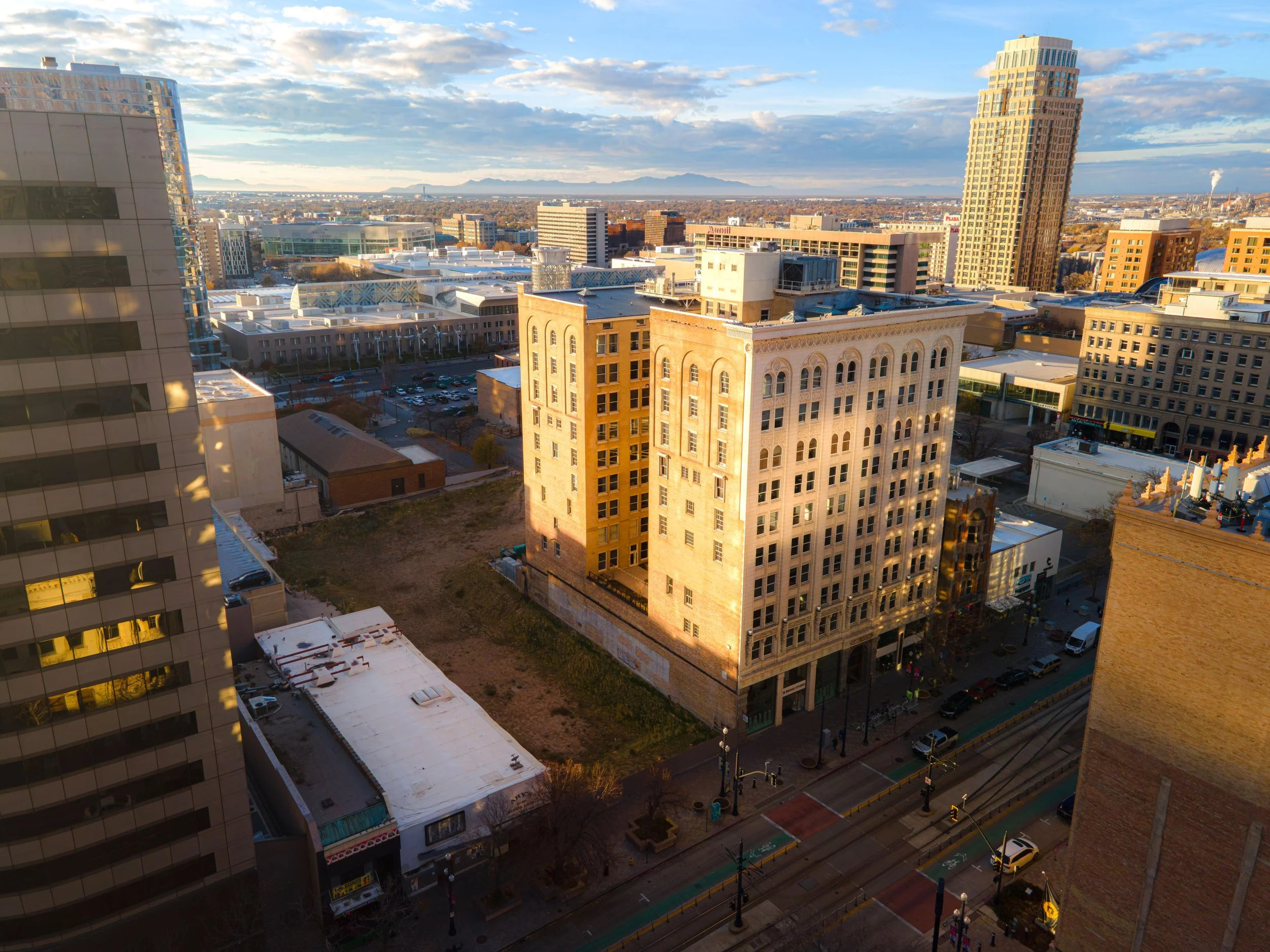
A short walk from Peter’s shop stands one of the most painful symbols of Salt Lake City’s choices: the Utah Theater, originally opened in 1918 as the Pantages. For over a century, its gilded interior hosted vaudeville, silent films, orchestras, civic events, and generations of memories. Even in its final, neglected years, the theater remained structurally sound and culturally irreplaceable.
But in the 2010s and early 2020s, the city weighed its future. Developers pitched a gleaming residential tower for the site, promising density, vibrancy, and tax revenue. Preservationists argued that the theater was itself an anchor — that dozens of cities across the country had revived their downtowns through historic restoration and performing arts centers. Salt Lake City chose the tower.
They demolished the theater.
Today, as of late 2025, there is no tower. There is only a deep pit in the ground, fenced off, gathering dust and windblown trash. A literal void on Main Street.
It is a painful metaphor. The theater was real, functional, historic, and beloved. The tower was hypothetical. The city chose the hypothetical over the real, the unbuilt over the built, the speculative over the proven. And now there is nothing — no performances, no lights, no cultural anchor, only the ghost of what once stood there and what could have been again.
The loss of the Utah Theater is not just an absence; it is a cautionary tale about a pattern repeated throughout the city’s postwar history: when we tear down the old before understanding its value, we often replace it with nothing at all.
Main Street’s vitality depends on continuity — on layering history rather than erasing it. The hole where the theater once stood is not just a missing building; it is a missing chapter of the city’s civic identity.
A People’s Main Street
The fire on August 11, 2025 was not the cause of Main Street’s challenges. It was the catalyst that made the city look in the mirror. It revealed how fragile the gains of the past decade had been — and how powerful they could become if supported rather than left to fend for themselves.
Main Street has survived saloons, Prohibition, economic depressions, freeway expansions, the rise and fall of malls, the flight to suburbs, corporate consolidation, and cycles of demolition. It has been dismissed as obsolete more times than anyone can count. But each time, people — real people — have stepped in to keep it alive: booksellers, bartenders, antique dealers, immigrants, chefs, tailors, musicians, builders, risk-takers, and memory-keepers.
Their collective story makes one truth unmistakable:
Main Street does not need saving. It needs choosing.
Cities become great not by accident but by stewardship — by protecting their small buildings, supporting their independent shops, encouraging walkability, curbing speculative demolition, investing in human-scaled places, and recognizing that the cultural value of a pub, a bookstore, a kilt shop, or an antique store cannot be measured in sales-per-square-foot.
Salt Lake City stands at a crossroads — quite literally, given the absence of the Utah Theater, the scars of the Main Street fire, and the rapid redevelopment sweeping the downtown core. The next decade will determine whether the city embraces the lessons of its past or repeats the missteps that hollowed out its historic streets.
The good news is this: the blueprint for revival already exists. It is written in the stubbornness of Peter Marshall, the resilience of Ken Sanders, the vision of the Bourbon Group, the craft of the Wellers, the charm of Edinburgh Castle, the history inside Utah Book & Magazine, the brickwork of the Daft Block, and the living memory carried by every merchant who has ever unlocked a Main Street door before sunrise
FACES of Utah profiles the leaders and change makers shaping our state.
Recognized for your impact?
[ Request Media Information ]