
MAZZA CAFE - ALI SABBAH
Mediterranean Cuisine
By Kyle Forbush | Photography by Dung Hoang
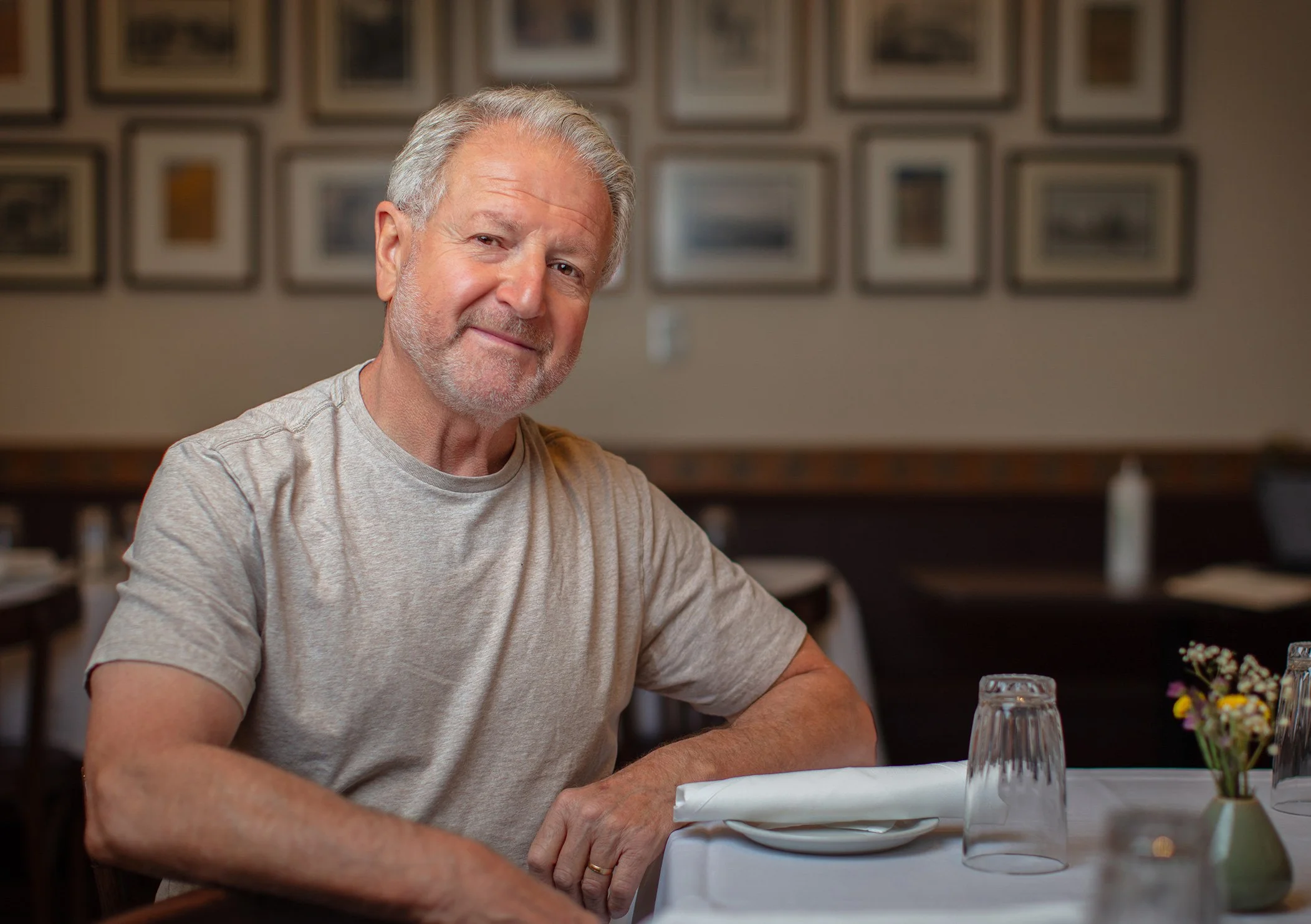
EARLY ONE MORNING THIS PAST APRIL, Ali Sabbah was sitting at home taking his first sips of coffee when he heard a knock at the door.
“Lo and behold, it was all of them,” Sabbah says, remembering opening the door and standing face to face with a galvanized group of employees from his restaurant, Mazza Café. They had come determined to convince Sabbah to fight to keep his restaurant of 26 years open.
Sabbah wasn’t entirely surprised. The day prior, he had gathered his closest staff members and warned them of Mazza’s imminent closure.
“Business had dropped,” Sabbah explains. “I sat them down and I said, ‘I’m getting very frustrated and I’m barely able to keep my head above water. I don’t know if we can survive. I think we’re basically looking to close at the end of next month.’”
The news hit hard for Sabbah’s carefully selected and trained pseudo-family of cooks, dishwashers, hostesses, and servers. “They didn’t look very happy,” Sabbah says. “They didn’t say anything, but they didn’t look very happy.”
Sabbah may not have been surprised at the group’s appearance at his house the next morning, but he was impressed, and deeply moved. For months, business at middle-class restaurants like Mazza had been up and down –– and not nearly consistent enough when many such places are still dealing with the fallout from loans they took out in order to stay open during the COVID-19 shutdown. Even with the GoFundMe that Sabbah organized in 2025, which raised nearly $200,000, allowing him to take care of some of the smaller, higher-interest loans he incurred six years ago, the larger ones continue to loom heavily.
Regardless of the financial woes threatening not only Sabbah’s sole remaining restaurant but also his house, which the Small Business Administration (SBA) required as collateral for their enormous and structurally unsound Economic Injury Disaster Loan (EIDL) program, the storied commitment he has to his employees won the day.
“It was something they believed in,” Sabbah says. “They knew they worked hard for everything. ‘You’ve got to give us a couple months,’ they said. ‘We want to work.’”
“And that’s why I’m so grateful to them,” he continues. “Now we’re surviving. We’re really managing things. We’re inching up a little bit, but we’ve still got a ways to go.”
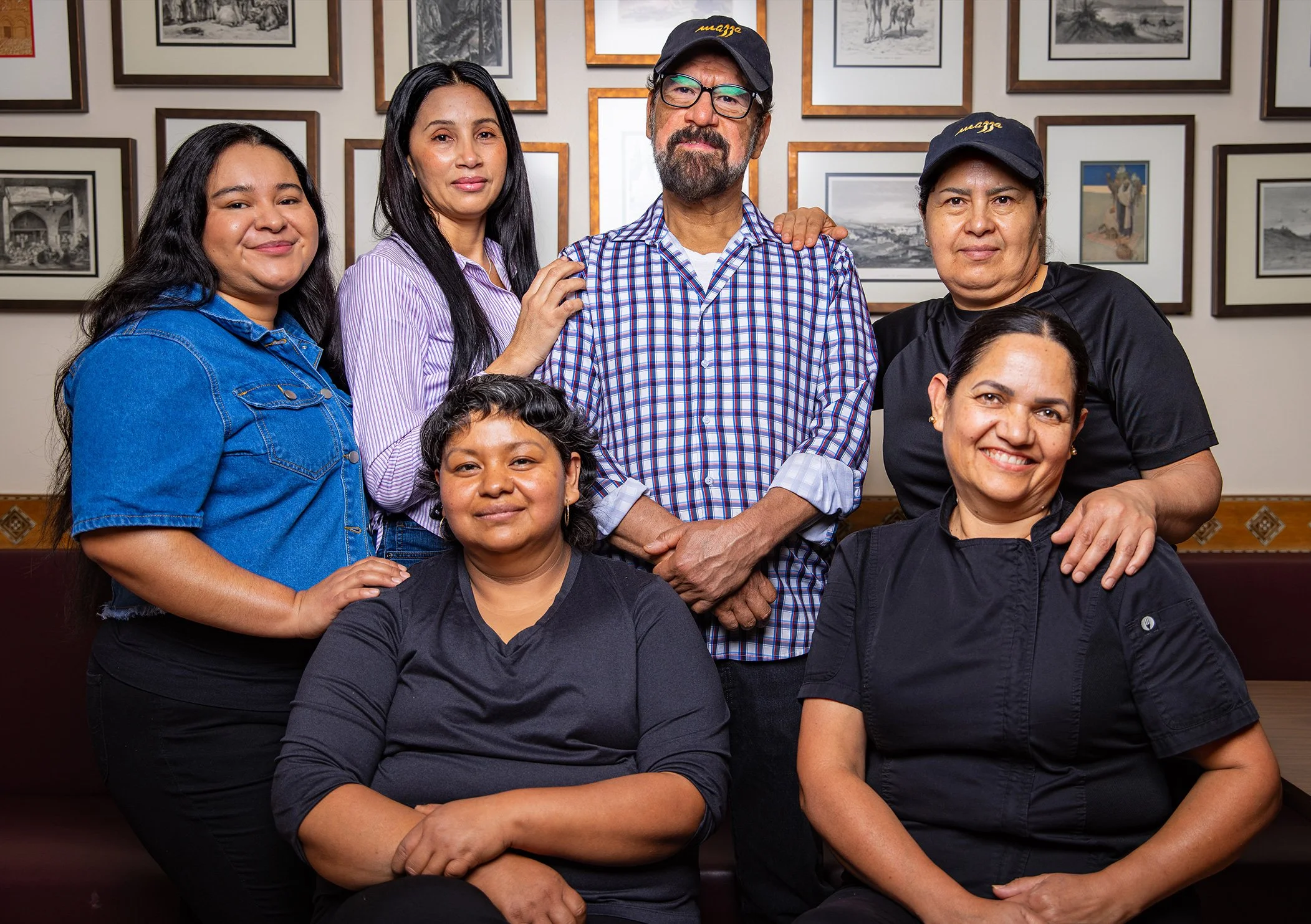
The Mazza “family”
Augustine Hernandez has been a cook at Mazza since it first opened in 2000. He was at the meeting in April, and despite being Sabbah’s most enduring, trusted employee, Hernandez credits kitchen supervisor Cecilia Urias with starting the group text that got everyone together for their brazen visit to Sabbah’s house that next day.
Hernandez is a man of few words, but what he does say about Sabbah encapsulates how intrinsic the management of people is to the 66-year-old restaurateur.
“He’s a very nice person,” Hernandez says. “I’ve been here for 26 years. He’s like my brother, my friend . . . everything.”
Anyone who’s worked for even a week in the service industry knows how rare it is that a cook could be at the same place for nearly three decades. But Sabbah runs Mazza a little differently than most restaurant managers. He plays to his peoples’ strengths in what is effectively a teaching kitchen, and he retains his cooks. For example, Hernandez, whose first job in the US after moving from Mexico was at Mazza, still makes the same dish that he began with –– the Potatoes Harra, one of Mazza’s most popular Levantine staples. Hernandez says, being particularly health-conscious, he prefers Lebanese food to even Mexican cuisine nowadays.
Mazza’s menu is anything but simple. It gets even more complicated when you consider how Sabbah refuses to compromise in the kitchen. He’s constantly looking for ways to improve on their elaborate cooking processes and only sources the best ingredients, like extra virgin olive oil and grass-fed beef.
But Sabbah’s own self-learned history has a major impact on how he teaches and trains his kitchen. He says that, when he moved to Utah in 1982, he simply missed the food his mother and aunts used to make back home. After a few other minorly successful business ventures, he took the hand-written recipes from his mother, contained in their letters back and forth from the US and Lebanon, and taught himself enough about cooking to open Mazza at its original and now last remaining location at the intersection of 15th and 15th in Sugar House, in 2000. Hernandez was one of his first employees. His sister, Victoria, arrived a few years later and also stayed around.
“One of the problems with a lot of kitchens is, you know, you’ve got somebody who just started a few months ago, somebody who’s been there a year or six months, and another cook who’s been there five or 10 years,” Sabbah says. “And then they’re all sort of clashing with each other, trying to gel.”
Sabbah’s kitchen is composed of five cooks including Urias, the kitchen supervisor, not including their two dishwashers, who work as diligently for Sabbah as anyone. In addition to seasoned Mazza veterans like Augustine and Victoria Hernandez, the team includes Maria Escobedo, Maria Cirilo, and the newest addition to their staff, Yulibel Tarreño. Each of them has different assigned tasks in the kitchen, and that too can change, depending on what they show an affinity for. Cirilo makes the salads and rice, while Victoria Hernandez, a Swiss Army knife of a cook, is responsible for their signature hummus, the Baba Ganooj, the Muhammara, rolling grape leaves, and anything else Sabbah can think to teach her. Each of the cooks also speak primarily Spanish. To make them feel even more at home, long ago Sabbah took it upon himself to become nearly fluent in Spanish.
“Keep your employees”
Escobedo started at Mazza’s State Street location in Sandy, which opened in 2019. Six months after some necessary and extensive renovations were finished, however, COVID and the shutdown happened, and Sabbah sold it. Around the same time, he was working on buying the building in the 9th and 9th district that had housed Mazza’s second location since 2007. When these two other restaurants closed, Sabbah was forced to consolidate a staff of nearly 100 employees and about 40-50 cooks down to a number closer to the 14 employees he has now, and he had to make some tough decisions on who to bring with him.
“I picked the best of the best and said, ‘You’re coming with me’,” Sabbah recalls.
Escobedo was a cook Sabbah chose to keep. With this smaller, core crew back at the original Mazza, Sabbah was able to return to what had brought him to the restaurant industry in the first place.
“It was actually a great opportunity for me to get back into the kitchen,” he says. “When you have three restaurants and nearly 100 employees, you’re a bean counter. You’re not a restaurateur anymore, you’re just plugging holes and spending hours answering emails at your desk. That wasn’t what I wanted to do when I got into this.”
After consolidating, Sabbah was able to focus more intently not only on his customers, but his employees as well. The core at Mazza hasn’t changed much since. In an industry notorious for having a revolving door, this may be a rarity, but it is not a mystery. Sabbah has cultivated talent and dedication in his staff the way a farmer cultivates crops –– with the correct ratio of tender love-and-care, and by instilling pride in the final product, their authentic Middle Eastern cuisine.
“We really work hard to improve every aspect of our kitchen performance and presentation,” Sabbah says. “You always tweak; you always think of something new. You can never actually say, ‘This is perfect.’ It’s never perfect. You examine how a dish looks coming out, the freshness and texture, and you look for what you can do to make it just a little bit more interesting and a better experience for the customer.”
The crew at Mazza works in a constant state of fluid harmony. Sabbah achieves this symbiosis not just by choosing the best of the best, but through personally tailored training and re-training, and with his contextually unique style of open-door leadership.
While you can’t always plan for high retention in the hiring process, Sabbah says, you can do something else to help foster this kind of synergistic work environment.
“Keep your good employees,” he says. “Keep them. Don’t treat every employee the same.”
The taste of perseverance
Besides ridding Sabbah of his smaller loan debt, part of the proceeds from the GoFundMe he started in 2025 also went towards giving raises to each of his employees, including Augustine and Victoria Hernandez, Maria Cirillo, Maria Escobedo, Cecilia Urias, and Yulibel Tarreño. This selfless use of money that otherwise could have helped with the EIDL, which Sabbah is still paying off in large sums every month, undoubtedly led to the crew showing up at his door on that recent April morning.
Now, the crew is going strong, providing a worldly dining experience in an intimate environment for the restaurant’s regulars and newcomers alike. People outside of the 1% are still being careful with their money, Sabbah says, and he knows that some days will be better than others. But they’ve added three new specials to the menu recently, and Sabbah says he’s happier than ever to be back at the Mazza location that started it all, with a crew that feels like family.
From that first dip of handmade hummus to the last drop of red wine, most of Mazza’s first-time patrons are from the surrounding neighborhood and turn into long-standing customers. This is because they’ve found Mazza to be a staple of the Salt Lake City dining scene that is indeed a bit of a hidden gem, but one that is simultaneously never to be overlooked.